Renter’s Insurance: What It Covers and Why You Need It
Renter’s insurance is inexpensive relative to what it protects, yet many renters skip it, assuming the landlord’s policy covers them. Knowing what it does and does not include makes the case for carrying it clear.
What Renter’s Insurance Typically Covers
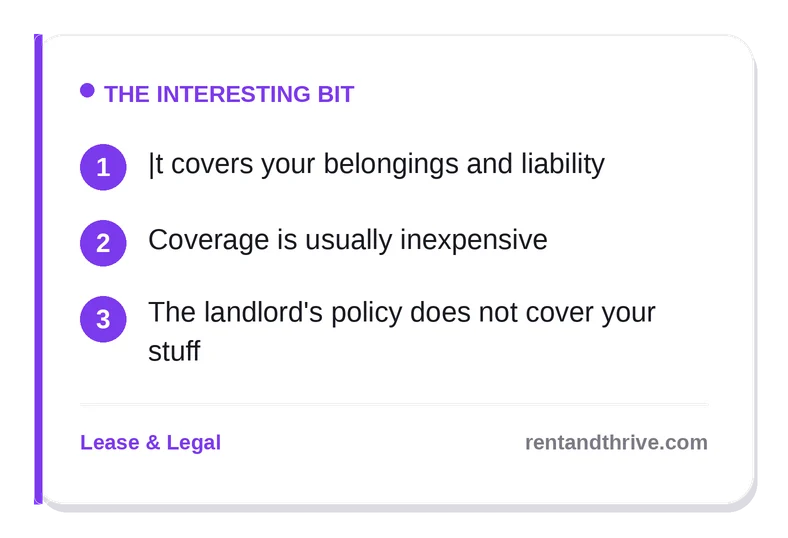
A standard renter’s policy generally covers your personal belongings against risks like theft and certain kinds of damage, provides liability protection if someone is injured in your unit or you accidentally damage others’ property, and often helps with additional living expenses if a covered event makes your home temporarily uninhabitable. The landlord’s insurance covers the building, not your possessions, which is the gap renter’s insurance fills.
For a relatively low monthly cost, the coverage can replace a lot of belongings and shield you from a liability claim that could otherwise be financially serious. That ratio is why many consider it well worth having.
What Renter's Insurance Covers, and the Gaps to Watch
Renter’s insurance is one of the best values in personal finance: for a small monthly premium it covers your belongings against theft, fire, and many kinds of damage, and, just as important, includes liability protection if someone is injured in your unit or you accidentally damage the property. Your landlord’s policy covers the building, not your possessions, so without your own coverage a single bad event can wipe out everything you own.
Read the policy for its limits and exclusions before assuming you’re covered. Standard policies often exclude floods and earthquakes, which need separate coverage, and may cap payouts on high-value items like electronics or jewelry unless you add a rider. Decide between actual-cash-value coverage, which pays the depreciated worth of items, and replacement-cost coverage, which pays to buy them new, the latter costs a little more but pays out far better after a loss. Many policies also fund temporary housing if your unit becomes unlivable. Inventory your belongings with photos and receipts so a claim goes smoothly. For the price of a few coffees a month, it’s coverage most renters shouldn’t skip.
The Gaps and Limits to Watch
Policies have boundaries worth knowing before you rely on them. Certain events, such as floods or earthquakes, are commonly excluded and may need separate coverage, and high-value items like jewelry or electronics may be capped unless specifically scheduled. Reading the policy’s covered perils and limits prevents unwelcome surprises at claim time.
It also helps to understand the difference between replacement-cost and actual-cash-value coverage, since the latter factors in depreciation and pays less. Keeping an inventory of your belongings, with photos and rough values, makes any future claim smoother and helps you choose a coverage amount that genuinely reflects what you own.
Choosing the Right Coverage Amount
Picking a coverage level starts with knowing roughly what your belongings are worth, which an inventory with photos and estimated values makes straightforward. Underinsuring leaves a gap if you ever need to replace everything, while paying for far more coverage than you own is wasteful, so an honest tally guides the right amount.
It is also worth deciding between replacement-cost and actual-cash-value coverage, since the former pays to replace items new while the latter factors in depreciation. Understanding the limits, deductibles, and any caps on high-value items helps you choose a policy that genuinely matches what you would need after a loss.
How Liability Coverage Protects You
Beyond covering your belongings, a renter’s policy typically includes liability protection, which is one of its most valuable and overlooked features. If someone is injured in your unit or you accidentally damage others’ property, liability coverage can help with the resulting costs, shielding you from a claim that could otherwise be financially serious. For a relatively low premium, that protection covers a meaningful risk.
Understanding that the landlord’s insurance covers the building, not your possessions or your liability, clarifies why a renter’s policy fills a real gap. The combination of belongings and liability coverage is what makes these policies worth far more than they cost for most renters.
The Value of Additional Living Expenses Coverage
Many renter’s policies also include coverage for additional living expenses, which can help if a covered event makes your home temporarily uninhabitable. If you have to stay elsewhere while repairs happen, this portion of the policy can offset some of those extra costs, a benefit that is easy to overlook until you need it. Knowing it exists helps you appreciate the full scope of the coverage.
As with all coverage, the specifics, limits, what events qualify, and how reimbursement works, are spelled out in the policy. Reading those details, rather than assuming, ensures you understand what support would actually be available after a disruption.
Choosing Coverage and Keeping an Inventory
Selecting the right coverage amount starts with knowing roughly what your belongings are worth, which a simple inventory with photos and estimated values makes straightforward. Underinsuring leaves a gap if you ever need to replace everything, while paying for far more than you own is wasteful, so an honest tally guides the right amount. It also helps to understand the difference between replacement-cost and actual-cash-value coverage.
Keeping that inventory updated and stored somewhere safe makes any future claim smoother and helps you choose a policy that genuinely reflects what you have. Reviewing the coverage periodically, as your possessions change, keeps it aligned with your needs.
Frequently Asked Questions
What does renters insurance cover?
Typically your personal belongings and liability, often for a low cost.
Does the landlord’s insurance cover my stuff?
No, the landlord’s policy covers the building, not your belongings.
Is it required?
Some leases require it, and it is inexpensive protection regardless.
Related reading
- Renters Insurance Explained: What It Covers and How Much You Actually Need
- Tax-Advantaged Accounts Every Renter Should Know About
- How to Invest $100 a Month as a Renter and Actually Build Wealth
- Dollar-Cost Averaging: How to Invest Consistently on a Renter’s Budget