Breaking a Lease Early: Your Options and Legal Rights
Sometimes you have to leave before the lease ends. Breaking a lease has financial and legal consequences, but handling it thoughtfully can limit the damage to both your wallet and your record.
Understanding Your Options and Obligations
A lease is a contract, so leaving early generally exposes you to costs, which may include rent until the unit is re-rented or a defined early-termination fee, depending on your agreement and local law. That said, many leases include an early-termination clause, and some situations, certain military orders, unsafe conditions, or other legally protected circumstances, may give you specific rights. The exact rules vary widely by state.
In many places a landlord has a duty to make reasonable efforts to re-rent the unit, which can reduce what you owe. Knowing both your obligations and any protections that apply to your situation is the starting point for a plan.
Breaking a Lease Early Without Wrecking Your Finances
Sometimes life forces an early exit, a job across the country, a safety issue, a relationship change, and breaking a lease doesn’t have to be a financial disaster if you handle it deliberately. Start with the document itself: many leases contain an early-termination clause spelling out the penalty, often one to two months’ rent, which at least makes the cost knowable rather than open-ended.
Before paying a penalty, learn your rights, because some situations carry legal protections that let you leave without penalty, including certain military deployments, documented unsafe conditions the landlord won’t fix, or domestic-violence circumstances in many states. If none apply, the most cost-effective route is usually cooperation: give as much notice as you can and offer to help find a qualified replacement tenant, since in many places landlords have a duty to try to re-rent rather than simply charge you for the empty months. Get any agreement to release you in writing, and confirm how it affects your deposit. Handled openly, an early exit becomes a manageable expense instead of a lingering debt or a damaged rental reference.
Breaking a Lease Without Wrecking Your Finances
Communication tends to produce the best outcomes. Telling the landlord early, in writing, and offering to help, by keeping the unit show-ready or even finding a qualified replacement tenant where subletting or assignment is allowed, can lead to a negotiated exit that costs far less than simply walking away. Getting any agreement in writing protects you afterward.
Leaving on bad terms, by contrast, can mean owing back rent, losing your deposit, and risking a negative reference or collections that affect future applications and credit. Because the details and your rights depend on local law, consulting a tenant resource or legal aid organization before you act can be money well spent.
Protecting Your Record on the Way Out
How you handle an early exit affects more than your immediate finances, it can shape future rental applications. Leaving on good terms, fulfilling negotiated obligations, and getting any agreement in writing help you secure a positive reference and avoid collections or disputes that could follow you. A clean exit is worth some effort.
Because the consequences and your rights depend heavily on local law and your lease, confirming the specifics, ideally with a tenant resource or legal aid organization, before you act protects you. Acting on accurate information, rather than assumptions, is the surest way to limit the fallout.
Checking the Lease’s Early-Termination Terms
Before doing anything else, reading your lease’s early-termination clause tells you what leaving early actually involves. Many leases specify a defined fee or process for ending the agreement early, which can be far less costly and stressful than simply walking away. Knowing whether such a clause exists, and what it requires, shapes your entire approach.
Your obligations and any protections depend heavily on your lease and local law, which vary widely. Some situations may give you specific rights, so understanding both the contract and the rules that apply to your circumstances is the necessary starting point for any plan.
Working With the Landlord on an Exit
Communication often produces the best outcome when you need to leave early. Telling the landlord as soon as possible, in writing, and offering to help, by keeping the unit show-ready or finding a qualified replacement tenant where subletting or assignment is allowed, can lead to a negotiated exit that costs far less than abandoning the lease. In many places a landlord also has a duty to make reasonable efforts to re-rent, which can reduce what you owe.
Getting any agreement in writing protects you afterward. A cooperative, early approach tends to preserve goodwill and minimize the financial fallout, whereas leaving on bad terms can mean owing back rent and risking a negative reference.
Knowing Your Rights Vary by Location
Whether and how you can break a lease, and at what cost, depends significantly on where you live, since landlord-tenant law differs by state and sometimes city. Certain circumstances may be legally protected, while others leave you responsible for the contract, so general assumptions can be misleading. Confirming your specific rights before acting prevents costly mistakes.
Because the details matter so much, consulting a local tenant resource or legal aid organization is often money well spent when an early exit looms. Acting on accurate, location-specific information, rather than guesswork, is the surest way to limit the consequences.
Acting on Accurate, Local Information
Because the rules around breaking a lease vary so much by location, acting on accurate, local information is the surest way to limit the consequences. What is permitted, what it costs, and what protections may apply all depend on your state and lease, so general assumptions can mislead. Confirming the specifics before you act prevents avoidable mistakes.
A local tenant resource or legal aid organization can clarify your rights and options, often at low or no cost. Pairing that guidance with early, written communication to your landlord gives you the best chance of a manageable, low-cost exit rather than a damaging one.
Frequently Asked Questions
Can I break my lease early?
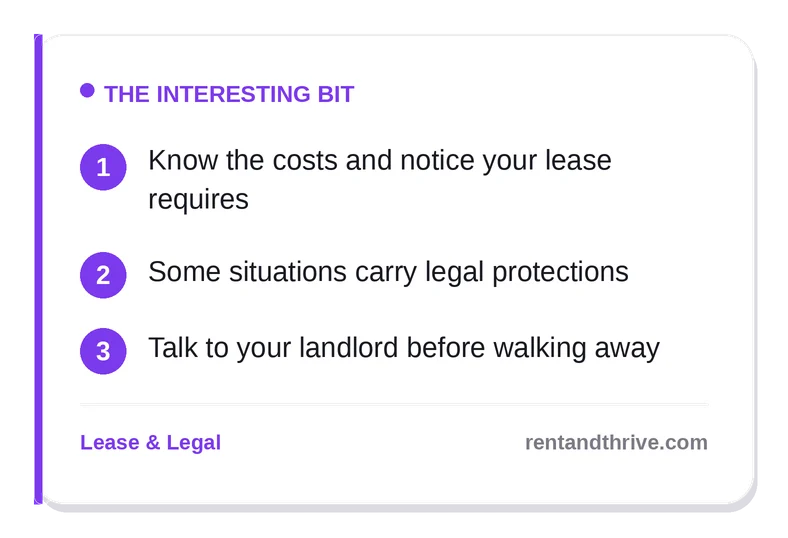
Sometimes, but know the costs and notice your lease requires first.
Are there protections?
Certain situations carry legal protections that vary by state.
What should I do first?
Talk to your landlord rather than simply moving out.
Related reading
- Rent Withholding and Repair-and-Deduct: Legal Remedies for Renters
- Landlord Entry Rights: When Can Your Landlord Come In?
- Lease Renewal: How to Negotiate Lower Rent (And Win)
- Month-to-Month vs. Annual Lease: Which Is Right for You?