Security Deposits: Your Rights, Deductions, and How to Get It Back
Your security deposit is your money, held in trust, and most disputes over it come down to documentation. A clear paper trail from move-in to move-out is the single best protection for getting it back.
Knowing Your Deposit Rights in Broad Strokes
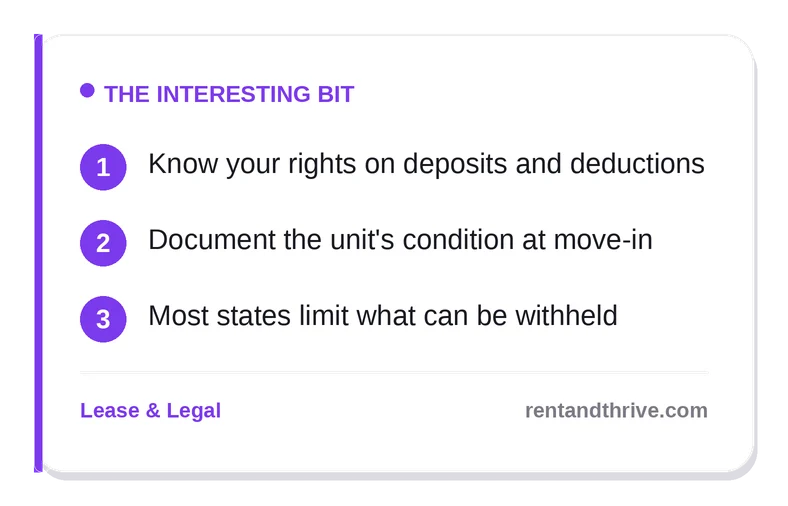
Most states regulate security deposits, often limiting how much a landlord can collect, setting a deadline to return it after you move out, and requiring an itemized statement for any deductions. Landlords can typically deduct for damage beyond normal wear and tear and for unpaid rent, but not for ordinary aging of the unit. The exact rules vary by location, so checking your state’s specifics is worthwhile.
Understanding the general framework helps you recognize when a deduction is questionable. Normal wear, faded paint, minor scuffs, worn carpet from regular use, is generally the landlord’s responsibility, not yours.
Building a Move-Out Paper Trail That Wins Deposit Disputes
Security-deposit law gives renters real protections, but you only get to use them if you can prove the unit’s condition. The single most effective habit is bookending your tenancy with documentation: a dated set of photos or video at move-in, and another at move-out, ideally after cleaning. Normal wear and tear, faded paint, minor carpet wear, isn’t legally deductible, but you need evidence to make that case.
When you move out, follow the lease’s checklist precisely, give the required notice in writing, and provide a forwarding address so the deposit, or an itemized list of deductions, can reach you within your state’s deadline. If your landlord misses that deadline or withholds money for ordinary wear, you generally have grounds to push back, and many states penalize landlords who keep deposits improperly. Send a polite written demand first, citing your photos and the relevant timeline. If that fails, small-claims court is designed for exactly these amounts. A clean paper trail turns a he-said-she-said standoff into a case you can actually win.
Building a Move-Out Paper Trail
The strongest defense is evidence gathered at both ends of the tenancy. Dated photos or video at move-in document any pre-existing flaws so you are not blamed for them, and a matching record after you clean at move-out shows the condition you left behind. Keeping the move-in inspection form and any written communication completes the file.
Following the lease’s move-out steps, giving proper notice, providing a forwarding address, and handling small fixes, removes easy reasons to withhold. If a landlord makes an improper deduction or misses the return deadline, a polite written demand citing your documentation is the usual first step, with small-claims court available as a backstop where warranted.
Handling a Deposit Dispute Calmly
If a deduction seems unfair or the deposit is not returned on time, a measured response usually works best. Start with a polite written request that references your documentation and the relevant deadline, since many disputes are resolved at this stage without escalation. Keeping the tone professional preserves your credibility.
Where a fair resolution does not come, small-claims court is a common avenue for deposit disputes, and tenant resources can explain your local process. Because the specifics vary by state, knowing your area’s deadlines and rules before you act strengthens your position considerably.
Why the Move-In Inspection Matters Most
The single most powerful protection for your deposit is the record you create at move-in, before you have changed anything. A thorough walkthrough with dated photos or video of every room, capturing existing scuffs, stains, and worn spots, establishes the baseline condition so you cannot be blamed later for pre-existing flaws. This is the evidence that wins most deposit disputes.
Completing any move-in inspection form the landlord provides, and keeping your own copy, reinforces that baseline. The few minutes this takes at the start of a tenancy can be worth a significant portion of your deposit at the end.
Communicating With Your Landlord in Writing
Throughout a tenancy, putting important communication in writing creates a paper trail that protects you, especially around anything that could affect your deposit. Requests for repairs, notes about the unit’s condition, and your move-out notice are all better documented in writing than handled verbally, since memories differ and written records carry weight if a disagreement arises.
Keeping copies of these messages, organized by date, means you can show exactly what was communicated and when. This habit costs nothing and consistently strengthens your position, whether you are requesting a fix or contesting a deduction.
Handling a Deposit That Isn’t Returned Fairly
If a landlord withholds part of your deposit for what looks like ordinary wear, or fails to provide the itemized statement many states require, you generally have grounds to push back. A polite written demand that references your move-in and move-out documentation and the applicable deadline is the usual first step and often resolves the matter without escalation.
Where a fair resolution does not come, small-claims court is a common avenue for deposit disputes, and many areas offer tenant resources that explain the local process. Because deposit rules and deadlines vary by state, knowing your specifics before you act strengthens your case considerably.
Understanding Normal Wear Versus Damage
Most deposit disputes hinge on the line between normal wear and chargeable damage. Ordinary aging, faded paint, lightly worn carpet, small nail holes, and minor scuffs is generally the landlord’s cost of doing business, while damage beyond reasonable use, like large holes, stains, or breakage, can usually be deducted. Knowing this distinction helps you judge whether a deduction is fair.
Because interpretations vary and the specifics depend on your state and lease, focusing on conditions you can clearly document is the safest approach. Anything you leave in better shape than the wear-and-tear standard is hard for a landlord to charge against, which is why thorough cleaning pays off.
Frequently Asked Questions
What can a landlord deduct from my deposit?
Generally unpaid rent and damage beyond normal wear, within state limits.
How do I protect my deposit?
Document the unit’s condition at move-in and move-out with photos.
Are deposit rules the same everywhere?
No, they vary by state, so check your local law.
Related reading
- How to Get Your Security Deposit Back in Full
- Landlord Entry Rights: When Can Your Landlord Come In?
- Breaking a Lease Early: Your Options and Legal Rights