
How Rent Reporting Services Can Boost Your Credit Score
Rent is likely your largest monthly payment, yet it usually does nothing for your credit. Rent-reporting services aim to change that by adding your on-time payments to your credit file, but the details determine whether it is worth it.
How Rent Reporting Works
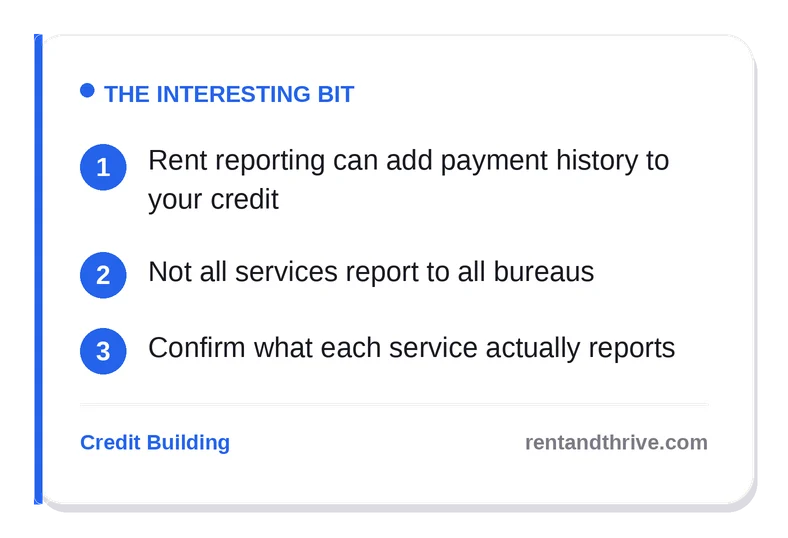
These services verify your rent payments and report them to one or more credit bureaus, so a payment you already make can start contributing to your credit history. For renters with thin files, adding a steady record of on-time housing payments can be a meaningful positive, since payment history is a core scoring factor.
The impact varies, though. Some services report to all three bureaus and others to just one, and not every credit score model weighs rental data the same way. Understanding which bureaus a service reaches helps set realistic expectations about what it can do for you.
Choosing a Rent-Reporting Service That Actually Counts
Rent is likely your largest monthly payment, yet it traditionally builds no credit because landlords don’t report it. Rent-reporting services close that gap by passing your on-time payments to the bureaus, turning a cost you already cover into credit history. For renters with thin files, it can be one of the highest-leverage moves available.
The services are not interchangeable, so vet them before signing up. Confirm which bureaus a service reports to, more is better, since a payment that reaches only one bureau helps only the score built on that bureau’s data. Check whether it can report past rent, which can add history retroactively, and compare fees, which range from free landlord-side programs to monthly tenant-paid subscriptions. Verify that your rent payments show up correctly after the first cycle. Remember the flip side: once rent is reported, a late payment can now hurt you, so only enroll when you’re confident you’ll pay on time, and treat the rent due date with the same seriousness as any other credit account.
Choosing a Service That Actually Counts
When comparing options, weigh the monthly or setup fees against the likely benefit, and confirm which bureaus receive the data. A service that reports to all three generally offers broader value than one limited to a single bureau. It is also worth checking whether past rent can be added and whether the reporting continues reliably month to month.
Some landlords and property managers offer rent reporting directly, sometimes at no cost to the tenant, which is worth asking about before paying for a third party. Whatever route you choose, the benefit only holds while your payments stay on time, so the service amplifies good habits rather than replacing them.
Pairing Rent Reporting With Other Credit Habits
Rent reporting can add a useful positive to a thin file, but it works best as one part of a broader strategy rather than a standalone fix. Combining it with on-time payments on other accounts and low utilization gives scoring models more positive data to work with, which compounds the benefit over time.
It is also worth remembering that not every score model weighs rental data equally, so the impact may vary by lender. Viewing rent reporting as a helpful supplement, while continuing the core habits that drive every credit score, keeps your expectations realistic and your overall credit moving in the right direction.
Which Bureaus and Score Models Count Rent
The benefit of rent reporting depends heavily on where the data lands, because not every service reports to all three bureaus and not every score model weighs rental payments the same way. A service that reports to all three generally offers broader potential benefit than one limited to a single bureau, so confirming the coverage before signing up sets realistic expectations.
Even when rent is reported, some scoring models incorporate it more than others, which means the impact can vary by lender and situation. For renters with thin files, though, adding a steady record of on-time housing payments can still be a meaningful positive, since payment history is a core factor.
Understanding these limits keeps rent reporting in perspective: it is a helpful supplement, not a guaranteed score jump. Pairing it with other good habits is what makes it count.
Asking Your Landlord and Weighing the Cost
Before paying a third party, it is worth asking whether your landlord or property manager already offers rent reporting, since some do, occasionally at no cost to the tenant. Larger management companies in particular may have this built into their payment systems, which would let you capture the benefit without an extra fee.
If you do use a paid service, weighing the monthly or setup cost against the likely benefit helps you decide whether it is worthwhile. Checking whether past rent can be added, and whether reporting continues reliably each month, affects the value you actually receive.
Because the benefit only holds while your payments stay on time, rent reporting amplifies good habits rather than replacing them. It works best as one piece of a broader credit strategy.
Pairing Rent Reporting With Core Credit Habits
Rent reporting works best as one part of a broader strategy rather than a standalone fix. Combining it with on-time payments on other accounts and low credit utilization gives scoring models more positive data to draw on, which compounds the benefit over time. On its own, reported rent helps a thin file, but alongside good habits it does more.
Keeping expectations grounded is wise, since the impact varies by bureau and score model. Viewing rent reporting as a useful supplement, while continuing the fundamentals that drive every credit score, keeps your overall credit moving in the right direction without over-relying on any single tactic.
Frequently Asked Questions
Can paying rent build my credit?
Through a rent reporting service, your on-time rent can be added to your credit history.
Do all services report to all bureaus?
No, confirm which bureaus each service reports to before signing up.
Is it worth it?
It can help thin credit files, but compare costs and what is reported.
Related reading
- Credit Utilization: The Number That Secretly Tanks Your Score
- How to Check Your Credit Score for Free (And What to Do Next)
- How to Start Investing When You’re Paying Rent
- How to Negotiate Rent on a New Apartment (Before You Move In)