How to Invest $100 a Month as a Renter and Actually Build Wealth
You do not need a large sum to begin investing. A consistent $100 a month, invested steadily over years, can grow into something meaningful, and the habit matters more than the amount.
Why Small, Consistent Investing Adds Up
Modest contributions feel insignificant in the moment, but consistency and time are what drive results. Investing a fixed amount regularly takes advantage of compounding, where returns themselves begin to earn returns, and of steady purchasing through market ups and downs. Over a long horizon, the regularity of the habit often matters more than the size of any single contribution.
For renters, the appeal is that $100 a month is achievable without a windfall or homeownership. Starting now with a small amount generally beats waiting until you can invest a larger one, because the early years of growth are the hardest to replace later.
Turning $100 a Month Into a Real Investing Habit
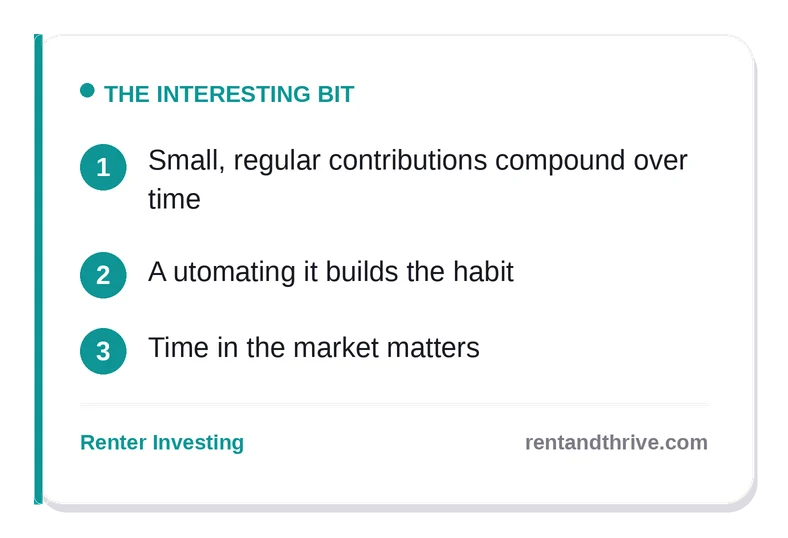
Investing $100 a month sounds too small to matter, but it’s enough to build genuine wealth because the engine isn’t the amount, it’s consistency plus time. Small, regular contributions compound over years, and the habit you establish at $100 is the same one you’ll scale to $300 or $500 as your income grows. The renters who end up wealthy are rarely the ones who invested a fortune once; they’re the ones who never stopped contributing.
Make it effortless and automatic. Set up a recurring transfer on payday into a low-cost, broadly diversified index fund inside a tax-advantaged account like an IRA, so the money is invested before you can spend it and automating it builds the habit. Don’t agonize over picking the perfect investment; a simple, low-fee fund is plenty for a beginner. Increase the amount whenever you get a raise or pay off a debt, redirecting that freed-up money straight into the contribution. Time in the market matters more than the size of any deposit, so the most important step is starting now with whatever you can sustain, and letting the years do the compounding.
Turning $100 a Month Into a Real Habit
The most reliable way to sustain it is to automate the contribution so it leaves your account on payday, before you can spend it, into a low-cost, diversified investment such as an index fund within a tax-advantaged account where appropriate. Automation turns investing from a monthly decision into a default, which is how small amounts actually accumulate.
As your income grows, raising the contribution, even slightly, accelerates progress without much felt sacrifice. Returns are never guaranteed and markets fluctuate, so a long-term view is essential, but the core lesson is that building the habit with $100 a month sets a foundation you can keep expanding.
Increasing the Amount as You Can
Starting with $100 a month builds the habit, and the next step is raising the amount as your budget allows. Even small increases, redirected from a raise or a trimmed expense, accelerate progress noticeably over the years thanks to compounding. The habit is the hard part; scaling it up is comparatively easy once it is automatic.
Because returns are never guaranteed and markets fluctuate, a long-term horizon remains essential, but the lesson holds: consistent, growing contributions matter more than any single month. Treating $100 as a floor rather than a ceiling is how a modest start becomes meaningful wealth.
Why Small Amounts Add Up Over Time
Modest contributions feel insignificant in the moment, but consistency and time are what drive results. Investing a fixed amount regularly takes advantage of compounding, where returns themselves begin to earn returns, and over a long horizon the regularity of the habit often matters more than the size of any single contribution. For renters, $100 a month is achievable without a windfall.
Starting now with a small amount generally beats waiting until you can invest a larger one, because the early years of growth are the hardest to replace later. The habit, not the amount, is what makes the difference over decades.
Automating $100 a Month
The most reliable way to sustain a $100-a-month habit is to automate it, so the money leaves your account on payday, before you can spend it, into a low-cost, diversified investment such as an index fund within a tax-advantaged account where appropriate. Automation turns investing from a monthly decision into a default, which is how small amounts actually accumulate.
Choosing a simple, diversified, low-cost option keeps the strategy hands-off and reduces the temptation to tinker. Setting it up once and letting it run is what allows a modest contribution to quietly build over the years.
Scaling Up as Your Income Grows
Starting with $100 a month builds the habit, and the next step is raising the amount as your budget allows. Even small increases, redirected from a raise or a trimmed expense, accelerate progress noticeably over the years thanks to compounding. The habit is the hard part; scaling it up is comparatively easy once it is automatic.
Because returns are never guaranteed and markets fluctuate, a long-term horizon remains essential. But treating $100 as a floor rather than a ceiling, and nudging it up over time, is how a modest start grows into something meaningful.
Choosing Simple, Low-Cost Investments
For a $100-a-month habit to do its work, the money is best directed into a simple, diversified, low-cost option such as a broad index fund, ideally within a tax-advantaged account where appropriate. Keeping costs low matters because fees compound against you over time, and simplicity reduces the temptation to tinker. A straightforward choice you can stick with beats a complicated one you second-guess.
Because returns are never guaranteed and markets rise and fall, a long-term horizon is essential. But pairing a modest, automated contribution with a low-cost, diversified investment is a sound, hands-off way for a renter to begin building wealth steadily.
Frequently Asked Questions
Can investing $100 a month make a difference?
Small, regular contributions can compound meaningfully over time.
How do I stay consistent?
Automate the contribution so it happens without effort.
What matters most?
Time in the market and consistency.
Related reading
- Dollar-Cost Averaging: How to Invest Consistently on a Renter’s Budget
- How to Use Your Employer’s 401(k) Match to Build Wealth Faster
- Index Funds for Beginners: The Easiest Way Renters Can Build Wealth
- How to Build a Zero-Based Budget on a Renter’s Income