Dollar-Cost Averaging: How to Invest Consistently on a Renter’s Budget
Dollar-cost averaging means investing a fixed amount on a regular schedule regardless of market ups and downs. For renters investing modest sums, it removes the pressure of trying to guess the right moment.
How Dollar-Cost Averaging Works
With dollar-cost averaging, you invest the same amount at set intervals, say monthly, so you automatically buy more shares when prices are low and fewer when prices are high. Over time this can smooth out your average purchase price and takes the emotion out of investing, since you are not reacting to every headline or market swing.
The approach pairs naturally with a paycheck, because you invest as money comes in rather than waiting to accumulate a lump sum. That rhythm is part of why it suits people building wealth gradually rather than all at once.
How Dollar-Cost Averaging Removes the Guesswork
Dollar-cost averaging means investing a fixed amount on a regular schedule regardless of whether the market is up or down, and it’s particularly well suited to a renter’s budget. By committing the same sum each payday, you automatically buy more shares when prices are low and fewer when they’re high, which smooths out your average purchase price over time and spares you from trying to guess the perfect entry point.
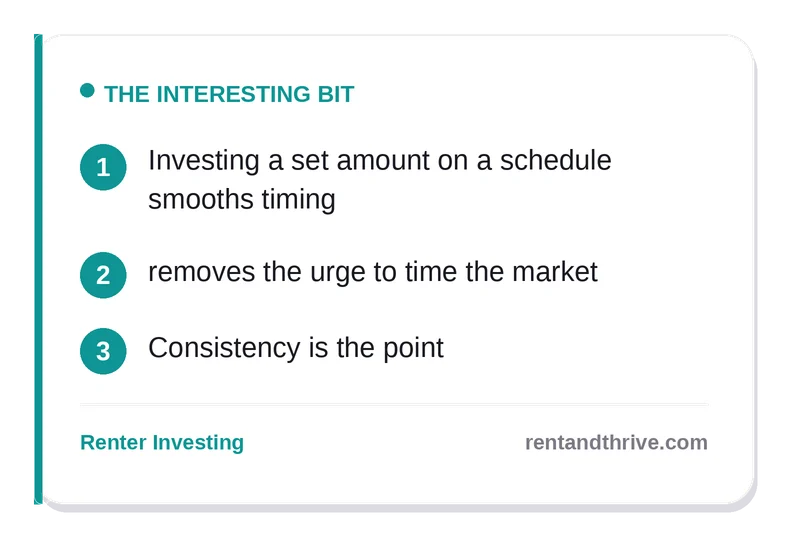
The deeper benefit is behavioral. The biggest threat to most investors isn’t the market; it’s their own impulses, panic-selling in a downturn or waiting on the sidelines for a dip that never comes. A set schedule removes the urge to time the market and turns investing into a routine that runs on autopilot through every mood swing in prices. Automate the transfer so it happens without a decision each month. Consistency, not cleverness, is the point: steadily investing through ups and downs has historically beaten waiting for ideal moments. For a renter building wealth on a modest, regular income, dollar-cost averaging matches the cadence of how you actually get paid.
Why It Removes the Guesswork
Trying to time the market, buying at the bottom and selling at the top, is notoriously difficult even for professionals, and getting it wrong can be costly. Dollar-cost averaging sidesteps that game entirely by committing you to a consistent plan, which is often more realistic and less stressful than attempting to outguess the market.
It is not a guarantee against losses, since markets can decline and investing always carries risk, but it instills the discipline of investing regularly through all conditions. For a renter on a budget, automating a steady contribution is a practical way to participate in the market without needing to predict it.
Staying the Course Through Market Swings
The real test of dollar-cost averaging comes during downturns, when the discipline to keep investing feels hardest but matters most. Continuing to buy on schedule when prices fall is precisely how the strategy works, since those lower-priced purchases can benefit you over the long run. Pausing out of fear undercuts the whole approach.
Automating the contributions removes much of the emotion, making it easier to stick with the plan through all conditions. Markets can decline and investing always carries risk, but a consistent, automated habit is a practical way to participate without trying to predict the next move.
Investing on a Schedule, Not a Hunch
Dollar-cost averaging means investing a fixed amount at regular intervals regardless of market conditions, which automatically buys more shares when prices are low and fewer when high. This steady approach can smooth out your average purchase price over time and removes the pressure of trying to guess the right moment to invest. For a renter on a budget, it fits naturally with a paycheck.
Because you invest as money comes in rather than waiting for a lump sum, the method suits building wealth gradually. The rhythm of regular contributions is part of why it works so well for people without large amounts to invest at once.
Why It Beats Trying to Time the Market
Timing the market, buying at the bottom and selling at the top, is notoriously difficult even for professionals, and getting it wrong can be costly. Dollar-cost averaging sidesteps that game by committing you to a consistent plan, which is more realistic and less stressful than attempting to outguess the market. It trades the hope of perfect timing for the reliability of a routine.
This does not guarantee against losses, since markets can decline and investing always carries risk, but it instills the discipline of investing through all conditions. Removing the guesswork is much of the method’s appeal.
Automating to Stay Consistent
The real test of dollar-cost averaging comes during downturns, when continuing to invest feels hardest but matters most. Buying on schedule when prices fall is precisely how the strategy works, since those lower-priced purchases can benefit you over the long run. Pausing out of fear undercuts the entire approach.
Automating the contributions removes much of the emotion, making it easier to stick with the plan through all conditions. Setting up an automatic transfer on payday turns dollar-cost averaging from a decision you have to make repeatedly into a habit that runs on its own.
Building a Routine You Can Sustain
The strength of dollar-cost averaging is that it turns investing into a sustainable routine rather than a series of stressful decisions. By committing to a fixed amount on a regular schedule, you remove the need to judge whether any given moment is a good time to invest, which is freeing for a busy renter. The routine itself becomes the strategy.
Sustaining it through both rising and falling markets is what allows the approach to work over the long run, and automation makes that consistency far easier. Because investing always carries risk and returns are not guaranteed, a steady routine paired with a long horizon is a sensible way to participate.
Frequently Asked Questions
What is dollar-cost averaging?
Investing a set amount on a regular schedule regardless of price.
Why use it?
It removes the temptation to time the market and builds a habit.
Does it guarantee gains?
No, it manages timing risk but does not remove market risk.
Related reading
- How to Invest $100 a Month as a Renter and Actually Build Wealth
- Renter Budget Templates: The 5 Best Free Options
- How to Build a Zero-Based Budget on a Renter’s Income
- Tax-Advantaged Accounts Every Renter Should Know About