Landlord Entry Rights: When Can Your Landlord Come In?
Your home is your private space, even as a renter, and the law generally limits when a landlord can enter. Knowing those limits helps you assert your privacy without unnecessary conflict.
The General Rules on Landlord Entry
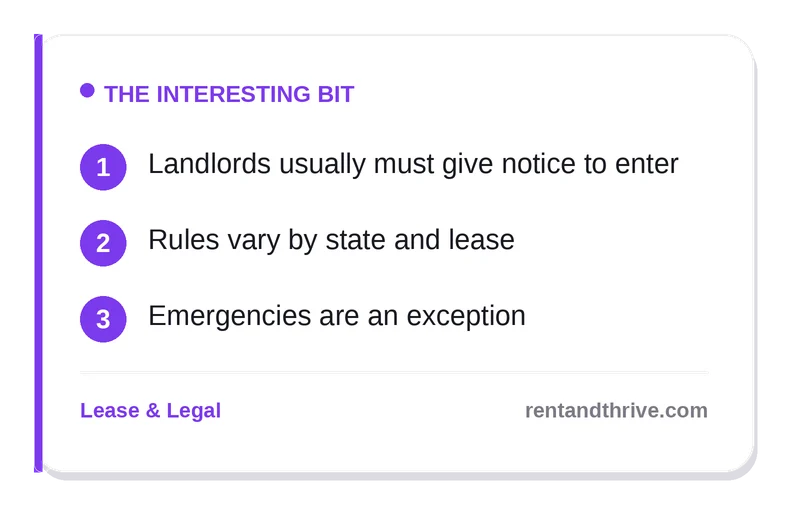
Most states require a landlord to provide advance notice, often a specified number of hours, and to enter only for legitimate reasons such as repairs, inspections, or showing the unit to prospective tenants or buyers. Entry is typically expected during reasonable hours rather than at any time. Genuine emergencies, like a burst pipe or fire, are the usual exception where immediate entry is allowed.
These protections balance the landlord’s need to maintain the property against your right to quiet enjoyment of your home. The specific notice period and permitted reasons vary by location and sometimes by lease, so your agreement and local law are the controlling details.
Knowing the Rules on Landlord Entry
Renting a home doesn’t surrender your right to privacy in it. In most places a landlord must give reasonable advance notice, commonly around 24 hours, before entering for routine reasons like repairs, inspections, or showing the unit to prospective tenants, and entry is generally expected during reasonable hours. The exact notice period and rules vary by location and should also be spelled out in your lease.
The clear exception is a genuine emergency, a burst pipe, a fire, a gas leak, where a landlord can enter immediately to prevent serious damage or protect safety. Outside of that, repeated unannounced visits, or entry used to harass, can violate your rights, and you have options if it becomes a pattern. Start by documenting each incident with dates and details, then raise it in writing, citing your lease and local notice requirements. Most entry conflicts resolve once expectations are stated plainly. Knowing the standard helps you tell a reasonable, lawful visit from an overstep, and respond proportionately rather than either tolerating intrusion or overreacting to a legitimate repair.
Handling Entry Issues Respectfully
If a landlord enters improperly or repeatedly ignores notice rules, the most effective first step is usually a calm, written reminder of the agreed terms and the relevant requirements. Documenting incidents, dates, times, and what happened, creates a record in case the pattern continues. Many issues resolve at this stage without escalation.
Where problems persist, tenants generally have avenues to enforce their rights, which may include local housing agencies or legal remedies, depending on the jurisdiction. Because the appropriate response depends on your state’s law, a local tenant resource can help you understand your options before taking further action.
Balancing Privacy With a Working Relationship
Asserting your entry rights does not have to mean conflict. Most issues resolve when a tenant calmly references the agreed notice terms and the landlord adjusts, so leading with a friendly reminder rather than an accusation usually keeps the relationship intact. A cooperative tone often gets better results than a confrontational one.
That said, persistent violations of your privacy are worth documenting and, if needed, escalating through the appropriate local channels. Knowing your rights lets you set boundaries confidently while still working constructively with a landlord on the routine, legitimate reasons they may occasionally need access.
Reasonable Hours and Valid Reasons for Entry
Most laws permit a landlord to enter only for legitimate purposes, such as repairs, inspections, or showing the unit, and typically during reasonable hours rather than at any time. Advance notice, often a specified number of hours, is usually required as well. These rules balance the landlord’s need to maintain the property against your right to quiet enjoyment of your home.
Understanding what counts as a valid reason, and the notice your jurisdiction or lease requires, lets you recognize when an entry is proper and when it is not. The specifics vary by location, so your lease and local law are the controlling details.
Documenting Improper Entry
If a landlord enters without proper notice or for reasons outside the permitted ones, keeping a record helps if the pattern continues. Noting the dates, times, and circumstances of each incident creates documentation you can reference, which is far more useful than relying on memory. A calm, written reminder of the agreed terms is usually the effective first response.
Most issues resolve at this stage without escalation. But where problems persist, having a documented history supports whatever further step may be appropriate, and a tenant resource can explain the options available in your area.
Communicating Boundaries Respectfully
Asserting your privacy rights does not have to create conflict, and a cooperative tone often gets better results than a confrontational one. Many entry issues stem from misunderstanding rather than bad faith, so leading with a friendly reminder of the notice terms tends to resolve them. Acknowledging the landlord’s legitimate, occasional need for access while setting clear expectations keeps the relationship workable.
If genuine violations continue despite a respectful reminder, escalating through the appropriate local channels remains an option. Knowing your rights lets you set boundaries confidently while still working constructively with your landlord on routine matters.
Reviewing Entry Terms in Your Lease
Because entry rules can be spelled out in your lease as well as in local law, reading what your agreement says about access is worthwhile. Some leases restate the notice period and permitted reasons, and knowing those terms before any issue arises lets you respond from a position of clarity rather than guesswork. Where the lease and local law differ, understanding both helps you know your footing.
If a clause seems to grant unusually broad entry rights, it is fair to ask about it or to check whether it is enforceable in your area. A local tenant resource can clarify how your lease’s entry terms square with the protections the law provides.
Frequently Asked Questions
Can my landlord enter without notice?
Usually they must give notice, though rules vary by state and lease.
What about emergencies?
Emergencies are typically an exception to notice requirements.
Where are the rules set?
In your lease and your state’s landlord-tenant law.
Related reading
- Breaking a Lease Early: Your Options and Legal Rights
- Security Deposits: Your Rights, Deductions, and How to Get It Back
- Renters Insurance Explained: What It Covers and How Much You Actually Need