
REITs: How Renters Can Invest in Real Estate Without Buying Property
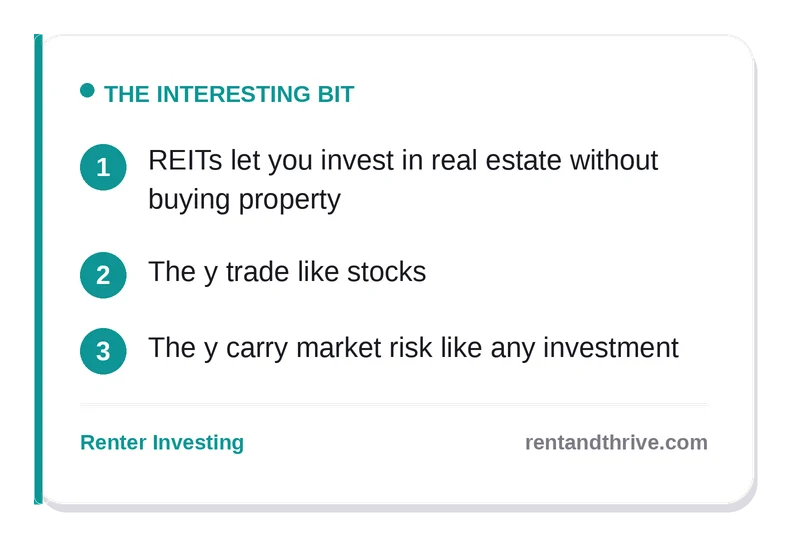
REITs let you invest in real estate without buying property, collecting a down payment, or becoming a landlord. For renters who want real-estate exposure, they offer an accessible alternative.
What REITs Are and How They Work
A real estate investment trust owns or finances income-producing property and trades much like a stock, so you can buy a share and gain exposure to real estate without owning a building yourself. REITs typically distribute much of their income to shareholders, which is part of their appeal, and they can be bought through ordinary brokerage accounts, sometimes within funds that hold many of them.
This structure gives renters a way to participate in real estate’s potential returns while keeping their money liquid, the opposite of the illiquidity that comes with owning a physical property.
REITs: Real-Estate Exposure Without a Down Payment
Renters who want a stake in real estate without buying property can get it through REITs, real estate investment trusts. These are companies that own income-producing properties like apartments, warehouses, and shopping centers, and they trade on exchanges much like stocks. Buying shares gives you a slice of a large real-estate portfolio for the price of a single share, no down payment, mortgage, or landlord duties required.
REITs are appealing for a few reasons: they’re required to pass most of their taxable income to shareholders, which often translates into meaningful dividends, and because they trade like stocks, they’re far more liquid than physical property you’d have to sell. They also carry market risk like any investment, prices fluctuate, and they can be sensitive to interest rates, so they belong as one piece of a diversified portfolio rather than a sole holding. You can buy individual REITs or, more simply, a REIT index fund for instant diversification. For a renter, they offer a practical way to participate in real-estate returns while keeping the flexibility that renting provides.
Real-Estate Exposure Without a Down Payment
The practical advantage for renters is access. Instead of saving for years toward a down payment and taking on a mortgage and maintenance, you can invest a small amount in a REIT or a REIT fund and adjust your position easily. That flexibility fits a renter’s situation far better than tying up capital in a single property.
Like any investment, REITs carry risk, their values fluctuate and they can be sensitive to interest rates and the property market, so they are best held as one diversified piece of a broader plan rather than a sure thing. Understanding how a particular REIT or fund invests, and its costs, helps you decide whether it fits your goals.
Fitting REITs Into a Diversified Plan
REITs are best viewed as one component of a diversified portfolio rather than a standalone bet. Because their values fluctuate and they can be sensitive to interest rates and the property market, holding them alongside other investments, rather than concentrating in them, helps manage risk. They add real-estate exposure without dominating your strategy.
Understanding how a particular REIT or fund invests, and what it costs, helps you judge whether it fits your goals. As with any investment, there are no guarantees, so a long-term view and sensible diversification matter more than chasing a single asset class.
How REITs Give Real-Estate Exposure
A real estate investment trust owns or finances income-producing property and trades much like a stock, so buying a share gives you exposure to real estate without owning a building yourself. REITs typically distribute much of their income to shareholders and can be bought through ordinary brokerage accounts, sometimes within funds that hold many of them. For renters, this is an accessible way to participate in real estate.
The structure keeps your money liquid, the opposite of the illiquidity that comes with owning physical property. That liquidity and low barrier to entry are what make REITs appealing to renters who want real-estate exposure without a down payment.
The Advantage of Liquidity and Low Entry
The practical advantage of REITs for renters is access. Instead of saving for years toward a down payment and taking on a mortgage and maintenance, you can invest a small amount in a REIT or REIT fund and adjust your position easily. That flexibility fits a renter’s situation far better than tying up capital in a single property.
Being able to buy and sell relatively easily also means your investment is not locked away when you might need it. This combination of low entry cost and liquidity is a meaningful contrast to traditional property ownership.
Holding REITs as One Piece of the Portfolio
Like any investment, REITs carry risk, their values fluctuate and they can be sensitive to interest rates and the property market, so they are best held as one diversified piece of a broader plan rather than a concentrated bet. Holding them alongside other investments helps manage that risk while still adding real-estate exposure. They complement a portfolio rather than replacing diversification.
Understanding how a particular REIT or fund invests, and what it costs, helps you decide whether it fits your goals. As with all investing, there are no guarantees, so a long-term view and sensible diversification matter more than chasing a single asset class.
Researching a REIT Before You Buy
Not all REITs are alike, so a little research before buying helps you choose ones that fit your goals. Understanding what kind of property or financing a REIT or REIT fund focuses on, and what fees it carries, gives you a clearer sense of its risk and how it might behave. Broad REIT funds offer more diversification than a single specialized trust.
Because their values fluctuate and can be sensitive to interest rates and the property market, REITs are best held as one part of a diversified plan rather than a concentrated position. As with any investment, there are no guarantees, so matching the choice to your goals and risk tolerance matters.
Frequently Asked Questions
What is a REIT?
A company that owns income-producing real estate, which you can invest in like a stock.
Can renters invest in real estate?
Yes, REITs let you invest in property without buying any.
Are REITs safe?
They carry market risk like any investment.
Related reading
- Renters Insurance Explained: What It Covers and How Much You Actually Need
- How to Invest $100 a Month as a Renter and Actually Build Wealth
- Emergency Fund vs. Investing: Which Should Renters Prioritize?
- Dollar-Cost Averaging: How to Invest Consistently on a Renter’s Budget