Credit Mix Explained: Why Renters Need More Than One Account Type
Credit scoring rewards handling different types of credit responsibly, which is the idea behind “credit mix.” It is a smaller factor than payment history, but for renters building a thin file it is worth understanding without overdoing it.
What Credit Mix Means and Why It Matters
Credit mix refers to the variety of account types on your report, such as revolving credit like cards and installment loans like a car or credit-builder loan. Scoring models view the ability to manage both kinds responsibly as a modest positive, which is why a file with only one account type may be seen as slightly less established.
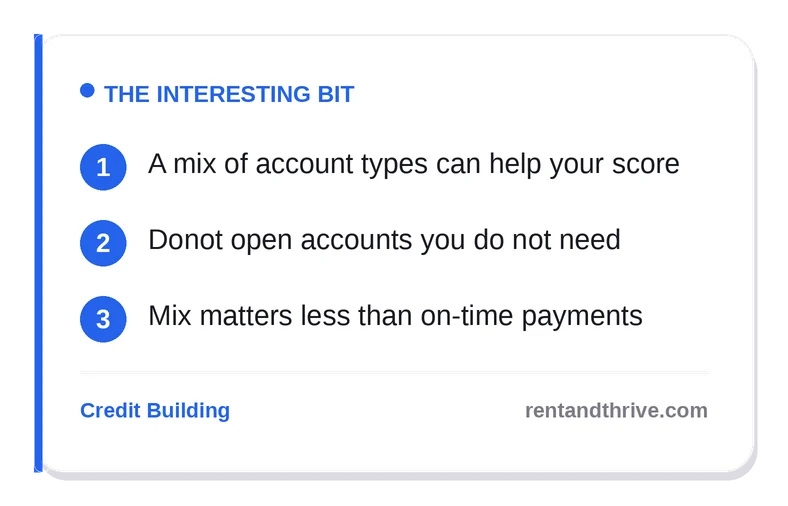
It is important to keep this in perspective. Mix is generally a minor ingredient compared with paying on time and keeping balances low, so it is not a reason to take on debt you do not need. It matters most as something that improves naturally over years rather than something to engineer quickly.
Building a Healthy Credit Mix Without Overextending
Credit-scoring models reward variety, a blend of revolving accounts like credit cards and installment accounts like loans, because handling different obligations responsibly signals lower risk. For renters whose files often consist of a single card, this factor can quietly cap an otherwise good score. But chasing a mix by opening accounts you don’t need is a trap that costs interest and invites debt.
The smart approach is to let your mix grow naturally alongside real needs. A credit-builder loan adds an installment line while doubling as forced savings. A secured card adds a revolving line. If you finance a phone or a modest purchase on fair terms, that too diversifies your file. The key is that each account serves a genuine purpose beyond the score. Mix is a minor factor compared with payment history and utilization, so never carry a balance or pay unnecessary interest just to diversify. Build the fundamentals first, and treat a richer credit mix as a bonus that arrives over time, not a goal to force.
Building Mix Without Overextending
The healthiest way to develop credit mix is to let it happen as your financial life grows, adding an installment loan when you genuinely need one rather than borrowing solely for the sake of variety. A credit-builder loan can serve double duty if you want a low-stakes installment account, but only if its cost is reasonable.
Opening accounts you do not need can backfire through new inquiries, lower average account age, and the temptation of extra available credit. The goal is responsible variety over time, not a checklist of account types acquired all at once.
Letting Your Credit Mix Develop Naturally
The healthiest credit mix is one that grows organically as your financial life does, rather than one assembled deliberately. Taking on an installment loan when you genuinely need a car or have a specific purpose adds variety without manufacturing debt, which is how mix is meant to improve. There is rarely a good reason to borrow solely to diversify.
Since mix is a minor scoring factor, it should never override the basics of paying on time and keeping balances low. Letting it develop on its own schedule, while you focus on the fundamentals, is both the safest and the most effective approach.
Revolving and Installment Credit Explained
Credit mix refers to handling different types of credit, primarily revolving accounts like credit cards and installment accounts like auto or personal loans. Revolving credit lets you borrow, repay, and borrow again up to a limit, while installment credit is a fixed amount repaid in scheduled payments. Scoring models view the ability to manage both responsibly as a modest positive.
For someone whose file contains only one type, often just a credit card, adding the other over time can slightly strengthen the profile. But this is a minor factor compared with paying on time and keeping balances low, so it is not worth taking on debt you do not need just to diversify.
Understanding the distinction mainly helps you recognize how your file looks to lenders, not to engineer it artificially. Mix tends to improve naturally as your financial life grows.
Letting Mix Develop Without Overextending
The healthiest way to build credit mix is to let it happen organically, adding an installment loan when you genuinely need one rather than borrowing solely for variety. A credit-builder loan can serve double duty if you want a low-stakes installment account, but only if its cost is reasonable. Opening accounts you do not need can backfire through new inquiries and a lower average account age.
Because mix is a small ingredient, it should never override the fundamentals. Focusing on on-time payments and low utilization will do far more for your score than assembling a checklist of account types.
Over years, as you finance a car or take on other credit for real reasons, your mix tends to round out on its own. Patience, here as elsewhere in credit, beats manufacturing.
Focusing on Fundamentals Over Mix
It is worth repeating that credit mix is a minor factor, so it should never pull focus from the basics that actually move a score. Paying every bill on time and keeping balances low will do far more than assembling a variety of account types, and chasing mix by taking on unnecessary debt can easily do more harm than good through new inquiries and added risk.
The sensible approach is to let mix develop naturally as your financial life grows and to keep your attention on the fundamentals in the meantime. A simple file managed well outperforms a diverse file managed poorly, every time, which is why mix is best treated as a bonus rather than a goal.
Frequently Asked Questions
What is credit mix?
The variety of account types you have, such as cards and loans.
Should I open accounts for the mix?
No, do not take on debt you do not need just for mix.
How much does mix matter?
Less than on-time payments and low utilization.
Related reading
- Hard vs. Soft Credit Inquiries: What Renters Need to Know
- Renters Insurance Explained: What It Covers and How Much You Actually Need
- HSA as an Investment Account: The Triple Tax Advantage Renters Ignore
- Eviction Process Explained: What Renters Need to Know