Index Funds for Beginners: The Easiest Way Renters Can Build Wealth
Index funds let you own a broad slice of the market in a single, low-cost investment, which is why they are a popular starting point for beginners. For renters building wealth, their simplicity is a feature, not a limitation.
What Makes Index Funds Beginner-Friendly
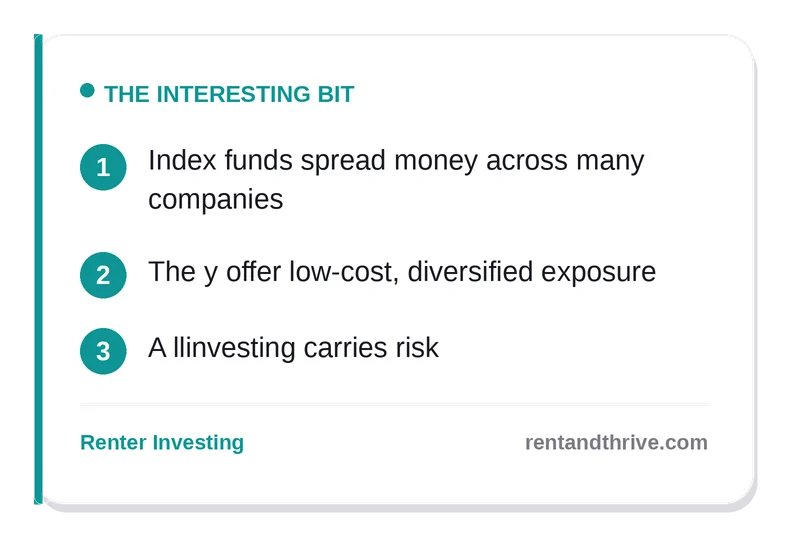
An index fund holds many securities to track a market index rather than trying to pick winners, which spreads risk across a wide range of companies in one purchase. This built-in diversification and typically low fees mean you do not need to research individual stocks or time the market, two things that trip up new investors most. You get broad market exposure with minimal effort.
Low costs matter more than they appear, because fees compound against you over decades just as returns compound for you. Index funds’ generally low expense ratios are a big part of why they suit long-term, hands-off investors.
Why Index Funds Suit Renters Building Wealth
Index funds have become the default first investment for good reason: instead of betting on individual companies, they spread your money across hundreds or thousands of them at once, giving you broad, low-cost, diversified exposure to the market. For a renter without time to research stocks, that built-in diversification removes a huge amount of risk and guesswork in a single purchase.
Cost is the other quiet advantage. Because index funds simply track a market rather than paying managers to pick winners, their fees are typically a tiny fraction of those charged by actively managed funds, and over decades those saved fees compound into real money. The trade-off to accept is that index funds won’t beat the market; they aim to match it, and all investing still carries risk, your balance will rise and fall. But for steadily building wealth on a renter’s budget, matching the market cheaply and automatically has historically outperformed most attempts to do better. Pick a broad, low-fee fund, contribute regularly, and let time and compounding, not constant tinkering, do the heavy lifting.
Why They Suit Renters Building Wealth
Index funds pair naturally with a renter’s situation: they are liquid, require no large minimum to begin in many cases, and reward steady, automated contributions over time. A renter can invest consistently without tying up money the way a down payment would, keeping flexibility intact while still building toward long-term goals.
The approach rewards patience rather than cleverness, contributing regularly and letting time do the work, which fits a busy life. As with any investment, returns are not guaranteed and values fluctuate, so a long horizon and a tolerance for ups and downs matter. For many beginners, though, a low-cost, diversified index fund is a sound foundation.
Keeping Costs and Emotions in Check
Two of the biggest threats to a long-term investor are high fees and emotional reactions, and index funds help with both. Their typically low costs mean less of your return is eaten away over the decades, while their broad diversification reduces the temptation to react to any single company’s swings. The approach rewards staying the course.
The discipline to keep contributing through downturns, rather than selling in a panic, is often what separates successful long-term investors from the rest. Because markets fluctuate and nothing is guaranteed, a patient, low-cost, hands-off strategy fits renters building wealth gradually better than frequent trading.
How Diversification Lowers Risk
An index fund holds many securities to track a market index rather than betting on individual winners, which spreads risk across a wide range of companies in a single purchase. This built-in diversification means one company’s poor performance has limited effect on the whole, smoothing out some of the volatility that comes with picking individual stocks. For beginners, that broad exposure is a major advantage.
Diversification does not eliminate risk, since the whole market can decline, but it reduces the chance that a single bad pick sinks your returns. That is much of why index funds are a popular, low-stress starting point for renters building wealth gradually.
Why Low Costs Matter So Much
Fees may look small in any given year, but they compound against you over decades just as returns compound for you. Index funds’ typically low expense ratios mean more of your money stays invested and working, which over a long horizon can make a meaningful difference in the end result. Keeping costs low is one of the few factors entirely within an investor’s control.
This is why comparing expense ratios when choosing a fund is worthwhile, since lower-cost options leave more for you. For a long-term, hands-off investor, minimizing fees is a quiet but powerful way to improve outcomes without taking on extra risk.
Staying the Course Through Ups and Downs
The discipline to keep contributing through downturns, rather than selling in a panic, is often what separates successful long-term investors from the rest. Index funds reward this patience because their broad diversification and low costs are built for the long haul, not for frequent trading. Reacting emotionally to market swings tends to lock in losses and miss recoveries.
Automating contributions helps remove the emotion, making it easier to invest steadily in all conditions. Because markets fluctuate and nothing is guaranteed, a patient, consistent approach fits renters building wealth far better than trying to outguess the market’s next move.
Why Index Funds Suit a Hands-Off Renter
Index funds fit renters who want to build wealth without managing investments closely, because they require no stock-picking or market-timing. Their broad diversification and typically low costs make them well suited to steady, automated contributions over a long horizon, which is exactly the kind of approach that fits a busy life. You can set up regular investing and largely leave it alone.
The strategy rewards patience and consistency rather than cleverness, and it keeps your money liquid compared with tying it up in property. Because returns are never guaranteed and values fluctuate, a long-term view matters, but for many beginners a low-cost, diversified index fund is a sound foundation.
Frequently Asked Questions
What is an index fund?
A fund that holds many companies to track a market index, offering diversification.
Why do beginners like them?
They are low-cost and spread risk across many holdings.
Are they risk-free?
No, all investing carries risk, including loss of principal.
Related reading
- How to Invest $100 a Month as a Renter and Actually Build Wealth
- How to Use Your Employer’s 401(k) Match to Build Wealth Faster
- Sinking Funds Explained: How Renters Can Prepare for Big Expenses
- Renters Insurance Explained: What It Covers and How Much You Actually Need