
Hard vs. Soft Credit Inquiries: What Renters Need to Know
Not all credit checks are equal. Soft inquiries are harmless, while hard inquiries can nudge your score down, so the timing of applications matters more than many renters realize.
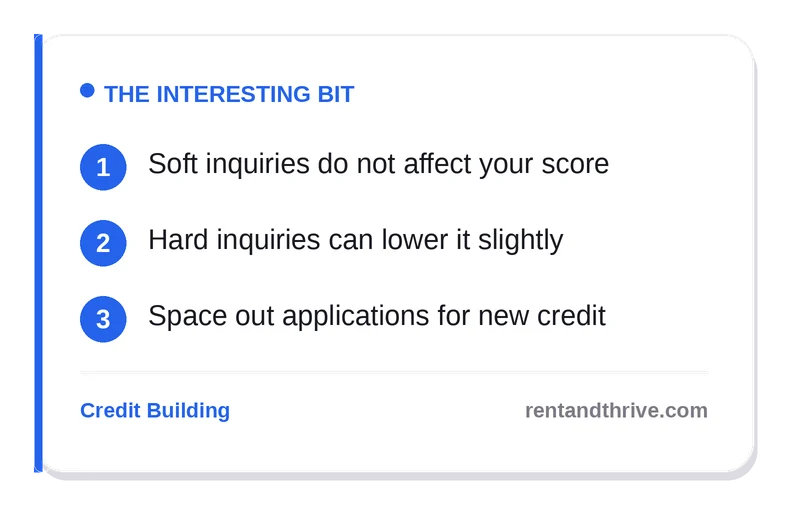
Hard vs. Soft Inquiries, and Their Effect
A soft inquiry happens when you check your own credit or a lender pre-screens you, and it has no effect on your score. A hard inquiry occurs when you formally apply for credit, and it can lower your score modestly and stay on your report for a couple of years. The practical difference is that applying has a small cost while looking does not.
A single hard inquiry is usually minor, but several in a short window can add up and may signal risk to lenders. That is why spacing out applications, rather than applying broadly and hoping something sticks, is generally the safer approach.
Timing Applications to Protect Your Score
The difference between a hard and soft inquiry matters more than most renters realize. Checking your own credit, or a lender pre-qualifying you, is a soft pull that never affects your score. A hard inquiry, triggered when you formally apply for credit, can shave a few points and lingers on your report for a couple of years, though its scoring impact fades within months.
A single hard inquiry is minor; the danger is clustering. Several applications in a short window can read as financial stress and compound the damage right when you may be trying to qualify for an apartment. So space out applications, and apply only when you’re reasonably confident you’ll be approved, using pre-qualification tools that rely on soft pulls to gauge your odds first. One useful exception: when rate-shopping for a single installment loan, scoring models typically bunch inquiries made within a focused period into one, so comparison shopping for the best rate won’t multiply the hit. Plan your applications, and the inquiry factor stays a footnote rather than a setback.
Limiting Inquiries Without Avoiding Credit Entirely
While too many hard inquiries can hurt, the answer is not to avoid applying for credit altogether, since responsibly used accounts build your history. The balance is to apply with purpose, only when you need an account and after some research into your odds, rather than scattering applications and hoping one is approved.
Checking whether you are likely to qualify before applying, and using pre-qualification tools that rely on soft pulls, lets you shop without unnecessary hits. Applied thoughtfully, occasional inquiries are a normal and harmless part of building credit.
Checking Your Odds Before You Apply
Because hard inquiries carry a small cost, applying strategically beats applying broadly. Using pre-qualification tools that rely on soft pulls lets you gauge your approval odds for many cards and loans without affecting your score, so you can apply mainly where you are likely to succeed. That keeps unnecessary inquiries off your report.
Spacing out applications and avoiding new ones right before a major credit pull, like an apartment screening, further protects your score when it matters most. Applied with a little planning, occasional inquiries are a normal, low-impact part of building credit.
What Triggers a Hard or Soft Inquiry
Knowing which actions cause which kind of inquiry helps you protect your score. A soft inquiry occurs when you check your own credit or a lender pre-screens you for an offer, and it has no effect on your score. A hard inquiry happens when you formally apply for credit, such as a loan, a credit card, or sometimes an apartment, and it can lower your score modestly for a time.
Because hard inquiries carry a small cost, applying with purpose rather than broadly keeps unnecessary ones off your report. Using pre-qualification tools that rely on soft pulls lets you gauge your odds without the hit.
A single hard inquiry is usually minor, but several in a short window can add up and may signal risk to lenders, so spacing out applications is generally wise.
Rate-Shopping Windows and Lasting Impact
For certain types of borrowing, scoring models often treat multiple inquiries of the same kind within a short period as a single event, which lets you compare offers without multiplying the impact. This rate-shopping allowance means responsibly comparing loan options in a focused window is treated more gently than scattering applications over months.
It also helps to avoid new applications right before a major credit pull, like an apartment screening, so your score is steady when it counts. Many landlords run a credit check, so knowing whether their process is a hard pull lets you plan around it.
The good news is that a hard inquiry’s effect is generally small and fades over time, with the inquiry itself dropping off your report after a couple of years. Applied thoughtfully, occasional inquiries are a normal part of building credit, not something to fear.
Applying for Credit Without Fear
While limiting unnecessary hard inquiries is wise, avoiding credit entirely is counterproductive, since responsibly used accounts are what build your history in the first place. The balance is to apply with purpose, only when you genuinely need an account and after some research into your likely approval, rather than scattering applications and hoping one sticks.
Checking your odds with soft-pull pre-qualification tools before applying lets you shop without unnecessary hits to your score. Approached this way, the occasional hard inquiry is simply a normal, low-impact part of building credit, not something to dread, and its small effect fades over time.
Frequently Asked Questions
What is the difference between hard and soft inquiries?
Soft inquiries do not affect your score; hard inquiries can lower it slightly.
When does a hard inquiry happen?
When you apply for new credit, like a card or loan.
How do I limit the impact?
Space out applications and only apply when needed.
Related reading
- Eviction Process Explained: What Renters Need to Know
- Credit Mix Explained: Why Renters Need More Than One Account Type
- Renters Insurance Explained: What It Covers and How Much You Actually Need
- Credit Building 101: A Complete Guide for Renters Starting from Zero