How Long Does It Take to Build Good Credit From Scratch?
There is no instant route to good credit, but the timeline is not a mystery either. Knowing which parts you can accelerate, and which simply require patience, keeps expectations realistic and effort focused.
Why Good Credit Takes Time
Some scoring factors are built on history that can only accumulate with the calendar. The length of your credit history and a long, unbroken record of on-time payments cannot be rushed, which is why someone starting from zero generally needs several months to generate a score and longer to reach a strong one. This is a feature of the system, not a failing on your part.
Negative marks also fade with time rather than vanishing on demand. As they age and are outweighed by newer positive activity, their drag lessens, but that recovery is measured in months and years, not days.
Why Credit Takes Time, and How to Speed the Parts You Control
The honest answer to how long building credit takes is that some of it simply can’t be rushed, because the length of your credit history is itself a scoring factor that only the calendar can improve. A brand-new file typically needs about six months of activity before a score even generates, and the strongest scores belong to people with years of clean history behind them.
What you can accelerate is everything else. Payment history and utilization together make up the bulk of your score, and both respond quickly to good habits, paying on time, every time, and keeping reported balances low can lift a young score within months. Avoid the self-inflicted delays: a single missed payment or a maxed-out card can set you back further than months of progress moved you forward. Open the right starter account early so the history clock starts sooner, then be patient with the part that’s purely time. Think of it as planting a tree, you can’t pull it taller, but good conditions get you there faster.
Speeding Up the Parts You Control
While you cannot fast-forward history, you can move the faster-acting factors. Lowering your credit utilization, paying every bill on time, and correcting any report errors can each produce noticeable improvement on a relatively short horizon, because they update with each reporting cycle.
Avoiding a rush of new applications also helps, since each can shave points and reduce your average account age. The most reliable plan is to set up automatic on-time payments, keep balances low, and then let consistency do the slow work that nothing else can replace.
Staying Motivated Through a Slow Process
Building credit rewards patience, which can be discouraging when results come gradually. Focusing on the actions within your control, on-time payments, low balances, error-free reports, rather than fixating on the score itself, keeps you moving even when the number rises slowly. Progress is happening beneath the surface long before it shows up dramatically.
Setting small milestones, such as reaching a certain number of on-time months, can make the journey feel more concrete. Over time, consistent habits compound into a solid score, and the slow start gives way to a track record that opens doors.
Why History Length Cannot Be Rushed
Some parts of a credit score are built purely on time, and no strategy can shortcut them. The length of your credit history and a long, unbroken record of on-time payments accumulate only with the calendar, which is why someone starting from zero generally needs several months just to generate a score and longer to reach a strong one. This is how the system works, not a reflection of effort.
Recognizing this helps set realistic expectations and reduces the temptation to chase quick fixes that rarely deliver. The most powerful thing you can do for the time-based factors is simply to start early and stay consistent.
Keeping your oldest accounts open also protects your average account age, which supports this part of the score over the long run. Time is an asset here, so beginning sooner is its own advantage.
How Negative Marks Fade and Staying Patient
Negative items do not vanish on demand, but their impact generally lessens as they age and as newer positive activity outweighs them. Rather than fixating on removing an accurate negative mark, the more reliable approach is to build a steady record of good behavior that gradually reduces its weight. Over time, consistency reshapes the overall picture.
Staying motivated through this slow process is easier when you focus on the actions within your control, on-time payments, low balances, error-free reports, instead of the score itself. Progress is happening beneath the surface long before it shows up dramatically in the number.
Setting small milestones, like reaching a certain stretch of on-time months, makes the journey feel concrete. The slow start eventually gives way to a track record that opens doors, which is the reward for patience.
Building Habits That Compound Over Time
Since good credit is built gradually, the most effective strategy is to set up systems that work without ongoing effort. Automating on-time payments, keeping balances low, and checking your reports periodically create a foundation that strengthens with each passing month. The habits matter more than any single action, because their effect compounds the longer they run.
Avoiding a rush of new applications also protects your average account age and limits inquiries, both of which support a rising score. Combined with patience, these consistent habits steadily transform a thin or damaged file into a solid one, doing the slow work that nothing else can replace.
Frequently Asked Questions
How long does it take to build good credit?
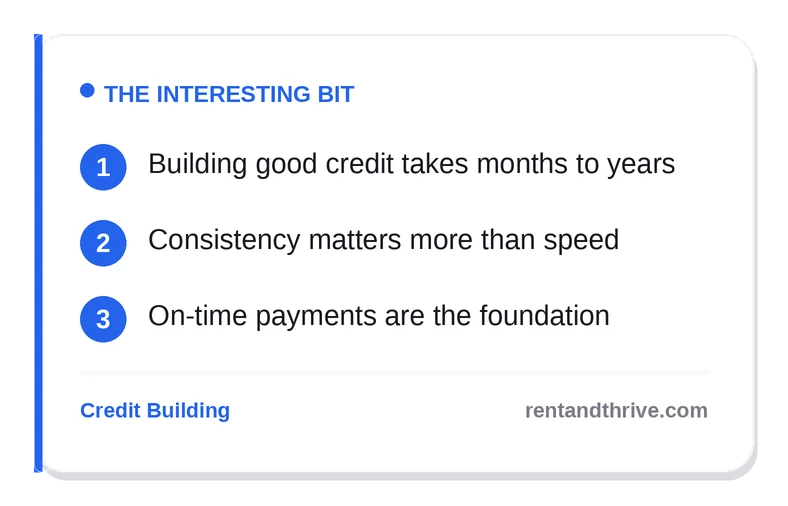
Generally months to years of consistent, on-time payments.
Can I speed it up?
Good habits compound over time; there is no instant fix.
What matters most?
Paying on time, every time, is the foundation.
Related reading
- Side Hustle to Investment: How to Turn Extra Income Into Long-Term Wealth
- How to Invest $100 a Month as a Renter and Actually Build Wealth
- How to Use Your Employer’s 401(k) Match to Build Wealth Faster
- Index Funds for Beginners: The Easiest Way Renters Can Build Wealth