
HSA as an Investment Account: The Triple Tax Advantage Renters Ignore
A health savings account is best known for medical expenses, but its tax treatment makes it a quietly powerful long-term investing tool, with one important catch about eligibility.
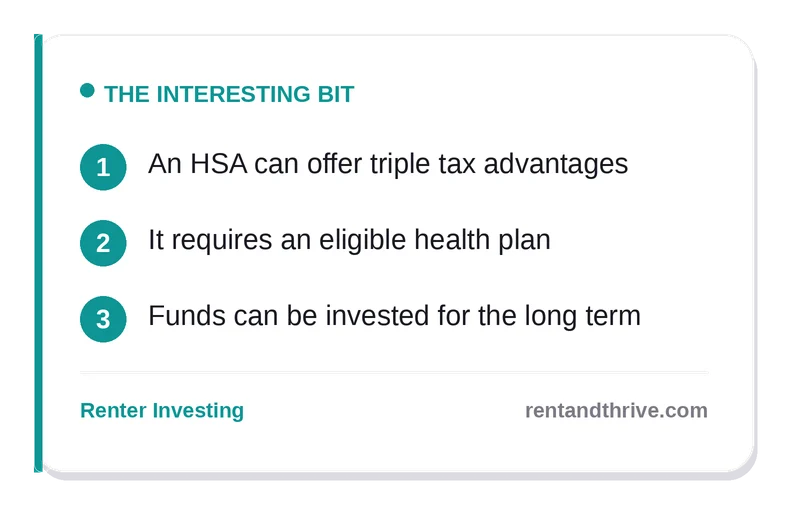
The HSA’s Triple Tax Advantage
An HSA offers a rare combination: contributions are generally tax-deductible, the money can grow tax-free if invested, and qualified medical withdrawals are tax-free as well. That three-way benefit is why some people treat an HSA not just as a spending account but as an additional tax-advantaged place to invest for the future, including health costs in retirement.
Many HSAs let you invest the balance once it passes a threshold, much like a retirement account, which is what unlocks the long-term growth potential beyond simply paying this year’s medical bills.
The HSA's Triple Tax Advantage, and Its Catch
A health savings account is quietly one of the most tax-efficient accounts available, yet many renters overlook it because it’s framed as a medical account rather than an investment. Its appeal is a rare triple tax advantage: contributions reduce your taxable income, the money grows tax-free, and withdrawals for qualified medical expenses are tax-free too. No other common account combines all three benefits.
The catch is eligibility, an HSA requires that you be enrolled in a qualifying high-deductible health plan, so it isn’t available to everyone, and a high-deductible plan only makes sense if it fits your health needs and budget. For those who qualify, the long-game strategy is powerful: rather than spending the balance on every minor expense, you can invest the funds, let them compound for years, and even pay current medical costs out of pocket while saving receipts to reimburse yourself later. After a certain age, non-medical withdrawals are taxed like an ordinary retirement account, giving it added flexibility. For an eligible renter, an invested HSA can become a stealth retirement account with unmatched tax treatment.
The Catch: Eligibility and Rules
The main catch is that you can only contribute to an HSA while covered by a qualifying high-deductible health plan, which is not right for everyone, particularly those who expect significant medical needs and prefer richer coverage. Choosing the plan purely for the HSA without weighing the deductible can backfire, so the health-coverage decision should come first.
There are also contribution limits and rules about what counts as a qualified expense, with taxes and penalties possible for non-qualified withdrawals before a certain age. Because the interplay of health coverage and tax rules is involved, confirming your eligibility and reviewing the details, ideally with a tax or benefits professional, helps you use the HSA’s advantages without tripping over its conditions.
Deciding Whether an HSA Fits Your Situation
The HSA’s tax advantages are appealing, but they only apply if a qualifying high-deductible health plan genuinely fits your health needs and budget. Choosing such a plan purely for the HSA, without weighing the higher deductible against your expected medical use, can backfire, so the coverage decision should come first.
For those who do qualify and can afford to pay routine medical costs out of pocket, letting the HSA balance grow as a long-term investment can be powerful. Because the rules around contributions and qualified expenses are detailed, a benefits or tax professional can help you decide whether the strategy suits you.
How the Triple Tax Advantage Works
A health savings account offers a rare combination of tax benefits: contributions are generally tax-deductible, the money can grow tax-free if invested, and qualified medical withdrawals are tax-free as well. This three-way treatment is why some people view an HSA not just as a spending account but as an additional tax-advantaged place to invest for the future, including health costs in retirement.
Many HSAs allow you to invest the balance once it passes a threshold, much like a retirement account, which unlocks long-term growth potential beyond paying this year’s bills. Understanding this dual nature, spending account and investment vehicle, is what reveals the HSA’s broader value.
Knowing the Eligibility Catch
The main catch is that you can only contribute to an HSA while covered by a qualifying high-deductible health plan, which is not right for everyone. Those who expect significant medical needs may prefer richer coverage, so choosing the plan purely for the HSA without weighing the higher deductible can backfire. The health-coverage decision should come first, with the HSA as a benefit rather than the driver.
For those who do qualify and can comfortably cover routine medical costs out of pocket, letting the balance grow can be powerful. Matching the plan to your actual health needs is what keeps the strategy from creating more cost than benefit.
Following the Rules to Keep the Benefit
HSAs come with contribution limits and rules about what counts as a qualified expense, and non-qualified withdrawals before a certain age can trigger taxes and penalties. Keeping records of medical expenses and understanding which withdrawals are qualified preserves the account’s tax advantages. The rules are specific enough that a little attention prevents costly mistakes.
Because the interplay of health coverage and tax rules is involved, confirming your eligibility and reviewing the details, ideally with a tax or benefits professional, helps you use the HSA’s advantages correctly. Used within the rules, it is one of the more flexible tax-advantaged tools available.
Frequently Asked Questions
Can I invest through an HSA?
Yes, with an eligible health plan, an HSA can be invested for the long term.
What is the tax advantage?
HSAs can offer tax benefits on contributions, growth, and qualified withdrawals.
Who can open one?
People with a qualifying high-deductible health plan.
Related reading
- Credit Mix Explained: Why Renters Need More Than One Account Type
- Renters Insurance Explained: What It Covers and How Much You Actually Need
- Side Hustle to Investment: How to Turn Extra Income Into Long-Term Wealth
- Emergency Fund vs. Investing: Which Should Renters Prioritize?