
The 50/30/20 Budget Rule: Does It Actually Work for Renters?
The 50/30/20 rule splits your after-tax income into roughly 50% needs, 30% wants, and 20% savings and debt payoff. It is a useful starting framework, but renters in expensive markets often find the “needs” slice is the first thing to break.
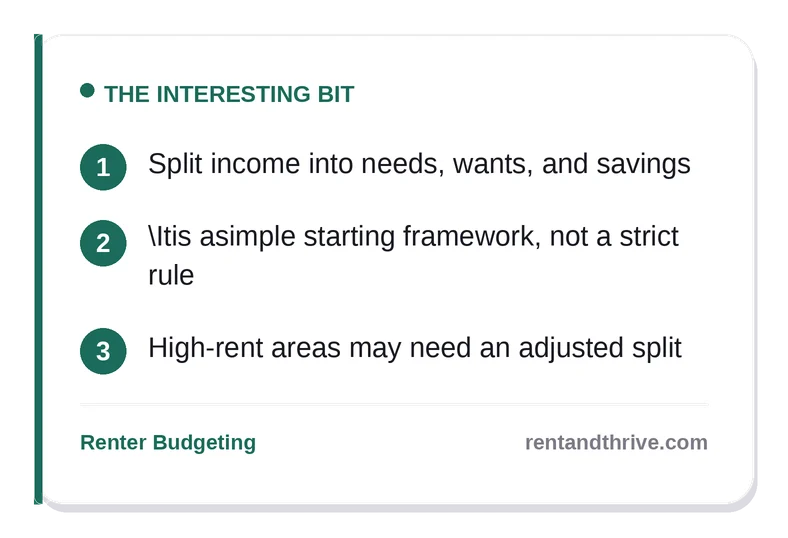
Where the 50/30/20 Split Helps and Where It Strains
The appeal of 50/30/20 is its simplicity: three buckets, easy math, and a built-in reminder to save. For renters whose rent lands near or below 30% of take-home pay, it can work almost out of the box and provides a quick gut-check on whether spending is drifting.
The strain shows up when rent alone eats 40% or more of income, which is common in high-cost cities. When that happens, the rigid percentages stop reflecting reality, and trying to force them can leave you feeling like you are failing at a budget that was never calibrated for your situation.
When the 50/30/20 Rule Breaks Down in High-Rent Cities
The 50/30/20 framework, half your take-home for needs, 30 percent for wants, 20 percent for savings, assumes rent fits inside the needs bucket. In expensive metros, rent alone can eat 40 percent of take-home, leaving no room for groceries, transport, and insurance inside the 50. When that happens, don’t abandon the rule; bend it. A 60/20/20 or even 70/20/10 split is honest about your housing reality while still protecting some savings.
The deeper value of the rule is the savings floor, not the exact percentages. Treat the 20 percent as a target to grow toward rather than a pass-fail test. If you can only manage 8 percent today, automate that 8 percent and raise it one point every time your income rises or you negotiate a bill down. Renters who anchor to the savings habit, instead of the precise ratios, end up ahead of those who quit the moment the math feels impossible.
Adjusting the Percentages to Your Real Numbers
Treat the ratios as a target to move toward, not a rule you must hit immediately. If housing pushes your needs to 60%, you might temporarily run something closer to 60/20/20 and protect the savings slice first, since that is the part that builds long-term security. The exact split matters less than keeping savings non-negotiable.
Over time, the most effective lever is usually the gap between income and fixed costs: a raise, a roommate, a cheaper renewal, or a side income can each shift the ratios back toward balance. The framework is most valuable as a recurring measurement, helping you notice when your spending mix is moving in the wrong direction.
Using the Rule as a Diagnostic, Not a Cage
Even when the exact percentages do not fit, the 50/30/20 framework is valuable as a checkup. Comparing your real spending to the targets quickly reveals whether wants are crowding out savings or whether housing is the true culprit, which tells you where to focus. The point is the insight, not rigid compliance.
Many renters use it as a periodic gauge rather than a daily rulebook, glancing at the ratios every few months to catch drift. Treated that way, it remains useful even in a high-rent market where hitting the literal numbers is unrealistic.
Sorting Needs From Wants in the Gray Areas
The hardest part of any percentage-based budget is deciding what counts as a need versus a want, because so much spending lives in between. Rent, basic groceries, utilities, and transportation to work are clearly needs, while entertainment and dining out are clearly wants, but items like a phone plan, a gym membership, or a streaming service depend on your circumstances. Being honest about these gray areas is what makes the 50/30/20 split meaningful rather than a way to relabel wants as needs.
A useful test is to ask what would happen if you paused the expense for a few months: if life would genuinely break down, it is closer to a need, and if it would just be less pleasant, it is a want. There is no universally correct line, so the goal is consistency in how you classify things, which lets you compare your spending honestly from month to month.
Alternatives When 50/30/20 Does Not Fit
If the 50/30/20 ratios simply do not work in your situation, often because rent alone consumes a large share of income, it is worth knowing that other frameworks exist. A pay-yourself-first approach flips the order by setting aside savings the moment you are paid and spending whatever remains, which protects the savings goal even when the needs slice is oversized. Others prefer a detailed line-item budget that ignores ratios entirely.
The best framework is the one you will follow, so treat 50/30/20 as one option rather than the only rule. Whatever method you choose, the underlying principles, spend less than you earn, save consistently, and avoid high-interest debt, matter far more than hitting any particular set of percentages.
Revisiting Your Ratios as Life Changes
Whatever split you settle on, it should not be permanent, because the right balance shifts with your income, your rent, and your goals. A raise, a move to a cheaper place, or paying off a debt can each create room to push more toward savings, while a rent increase might temporarily force the needs slice higher. Revisiting the ratios periodically keeps them tied to reality rather than to a number you set long ago.
The savings portion is the one worth protecting through these changes, since it is the part that builds long-term security and the easiest to quietly let slip. Treating the percentages as a target you steer toward over time, rather than a fixed rule, lets the framework stay useful across very different seasons of your financial life.
Frequently Asked Questions
What is the 50/30/20 rule?
A guideline to put about half your income toward needs, a third toward wants, and the rest toward savings and debt.
Does it work in high-rent cities?
Often the split needs adjusting, since rent alone can exceed the needs portion.
Is it a strict rule?
No, it is a starting framework to adapt to your situation.
Related reading
- Grocery Budget Hacks That Actually Work for Renters
- Renters Insurance Explained: What It Covers and How Much You Actually Need
- How to Invest $100 a Month as a Renter and Actually Build Wealth
- Emergency Fund vs. Investing: Which Should Renters Prioritize?