DIY vs. Hiring Movers: A Real Cost Comparison
Hiring movers versus doing it yourself is a classic trade-off between money, time, and effort. A clear-eyed cost comparison, including the costs that do not show up on an invoice, leads to the right call.
Counting the Real Cost of Each Option
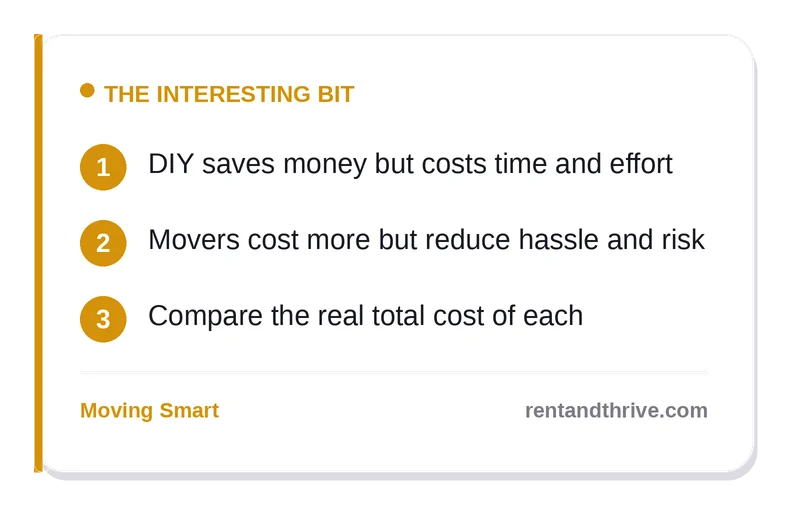
The DIY route looks cheaper on paper, mainly a truck rental and supplies, but the full cost includes fuel, equipment, your time, and the physical effort and risk of moving heavy items yourself. Hiring movers costs more upfront but bundles labor, transport, and often equipment, while sparing you the work and some of the injury risk. Comparing them fairly means counting both the dollars and the hidden costs.
Distance and volume tilt the math. A small local move may strongly favor DIY, while a long-distance move or a household full of heavy furniture can make professional help surprisingly competitive once you value your time and effort honestly.
DIY vs. Movers: Counting the Real Cost
The DIY-versus-movers decision looks obvious until you count everything. A rental truck advertised at a low daily rate quickly grows once you add mileage, fuel, insurance, equipment like dollies and pads, and possibly a night’s lodging on a long haul. Stack on the value of a full day, or two, of your own time and the help you’ll owe friends, and the gap between doing it yourself and hiring pros narrows more than people expect.
Professional movers cost more up front but bundle labor, equipment, and liability coverage, and they’re dramatically faster and easier on your body, which matters for a fourth-floor walk-up or a cross-country distance. The right answer depends on your move’s size, distance, and your own capacity. A small studio across town is a classic DIY job; a large apartment moving several states is where hiring help often wins once you price your time and the risk of injury or damage honestly. Whichever you choose, get itemized quotes so you’re comparing true totals, not sticker prices, and the smarter call usually becomes clear.
Choosing Based on Your Situation
DIY tends to win for renters with little furniture, a short move, and willing helpers, where the savings are real and the effort is manageable. Movers make more sense when you have heavy or fragile items, a tight schedule, physical limitations, or a long haul that would otherwise eat an entire exhausting day or more.
A middle path, hiring labor only to load and unload while you handle the truck, or using a container service, often captures much of the savings with less of the strain. Getting a couple of quotes before deciding turns the comparison from a guess into a concrete choice.
Getting Accurate Quotes Before Deciding
The DIY-versus-movers math only works if your numbers are realistic, so gathering actual quotes is worth the time. A couple of mover estimates and a real tally of truck rental, fuel, supplies, and equipment turn a vague guess into a concrete comparison. Costs vary enough by distance and volume that assumptions can mislead.
When requesting mover quotes, confirming what is included, labor, transport, insurance, any extra fees, avoids surprises on the invoice. With accurate figures for both options in hand, the right choice for your specific move usually becomes clear.
Tallying the True Cost of DIY
A do-it-yourself move looks cheapest on paper, but an honest tally includes more than the truck rental. Fuel, mileage, equipment like dollies and pads, packing supplies, and the value of your own time and effort all belong in the comparison, along with the physical risk of moving heavy items yourself. Counting these gives a fairer picture than the rental price alone.
For a small local move with willing helpers, DIY often still wins clearly. But as distance and volume grow, the hidden costs and effort mount, which is why a complete tally, not just the sticker price, should drive the decision.
Understanding What Movers Include
Hiring movers costs more upfront but bundles labor, transport, and often equipment, while sparing you the work and some of the injury risk. When comparing quotes, confirming exactly what is included, loading and unloading, transport, any insurance, and potential extra fees, prevents surprises on the invoice. A clear quote makes the comparison with DIY meaningful.
Movers tend to make the most sense for long-distance moves, heavy or fragile items, tight schedules, or physical limitations. Valuing your time and effort honestly often makes professional help more competitive than it first appears, especially when a DIY move would consume an exhausting full day or more.
Choosing a Hybrid Approach
The decision is not strictly all-or-nothing, and a middle path often captures much of the savings with less strain. Hiring labor only to load and unload while you drive the truck, or using a portable container service that you pack at your own pace, blends affordability with reduced effort. These options suit renters who want to save but cannot manage a full DIY move alone.
Getting a couple of quotes for each approach turns the comparison from a guess into a concrete choice. Matching the mix to how much you are moving, how far, and your own capacity is what leads to the right, cost-effective decision.
Matching the Choice to Your Move
The right answer to the DIY-versus-movers question depends heavily on your specific move. A small local move with few belongings and willing helpers often favors DIY clearly, while a long-distance move, heavy furniture, a tight schedule, or physical limitations can make professional help surprisingly worthwhile. There is no universal answer, only the one that fits your situation.
Getting concrete quotes for each option, and honestly valuing your own time and effort, turns the decision from a guess into a clear comparison. Considering a hybrid approach often captures much of the savings while reducing the strain, which suits many renters best.
Frequently Asked Questions
Is it cheaper to move myself?
DIY usually costs less in money but more in time and effort.
When are movers worth it?
For long distances, heavy items, or tight schedules.
How do I decide?
Compare the real total cost, including your time and risk.
Related reading
- REITs: How Renters Can Invest in Real Estate Without Buying Property
- Dollar-Cost Averaging: How to Invest Consistently on a Renter’s Budget
- Renters Insurance Explained: What It Covers and How Much You Actually Need