
What Is a Co-Signer and When Do You Need One?
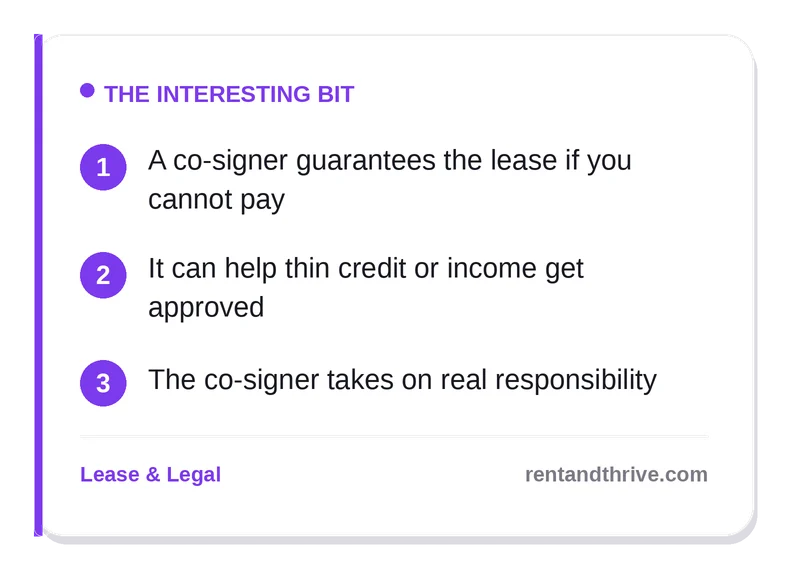
A co-signer agrees to take responsibility for your lease if you cannot pay, which can make approval possible when your own application falls short. It is a serious commitment that both parties should fully understand.
When a Co-Signer Helps
Landlords may ask for a co-signer when an applicant has limited credit history, a low score, insufficient income relative to the rent, or no rental track record. A co-signer with strong finances reassures the landlord that the rent will be paid, which can turn a borderline application into an approval, common for students, recent graduates, or renters rebuilding credit.
The co-signer typically does not live in the unit; their role is purely financial backing. Understanding that distinction helps both sides approach the arrangement with clear expectations.
Co-Signers: What They're Really Agreeing To
A co-signer is someone with stronger credit or income who guarantees your lease, promising to cover the rent if you can’t. For renters with thin credit, no rental history, or income that looks light on paper, a co-signer can turn a rejection into an approval. But it’s a serious favor, and both sides should understand the weight of it before anyone signs.
The co-signer takes on real, legal liability: if you miss rent, the landlord can pursue them for the full amount, and the obligation can affect their own credit and ability to borrow. That’s why the right co-signer is usually a close family member who trusts your reliability and can genuinely afford the risk. Be transparent about your finances with them, agree on what happens if money gets tight, and treat the arrangement as temporary, a bridge while you build your own qualifying history. Once your credit and rental record stand on their own, you can release them on the next lease. Honoring every payment is how you protect both the relationship and their finances.
What a Co-Signer Is Really Agreeing To
A co-signer is generally on the hook for the full obligation, missed rent, damages, and other costs, often for the entire lease term, not just a portion. Depending on the agreement and local law, the landlord may be able to pursue the co-signer directly, and the obligation can affect the co-signer’s own credit and finances if things go wrong.
Because the stakes are real, both people should read the co-signer agreement carefully and discuss what happens if money gets tight. Clarity up front, and a backup plan, protects the relationship as much as the finances. When the terms are significant or unclear, reviewing them with a knowledgeable resource is sensible.
Alternatives to Bringing On a Co-Signer
Because co-signing is a serious commitment, it is worth exploring whether you can strengthen an application without one. Offering a larger deposit or some rent in advance where permitted, providing strong references, or demonstrating stable income can sometimes satisfy a landlord on their own. Targeting more flexible, individually owned rentals can also reduce the need for a co-signer.
If a co-signer is still required, choosing someone who fully understands the obligation, and agreeing in advance on what happens if money gets tight, protects both of you. The relationship is worth more than any apartment, so clarity up front matters.
Who Can Serve as a Co-Signer
A co-signer is typically someone with strong, stable finances who agrees to back your lease, often a parent or close relative, though it can be anyone a landlord will accept. They generally do not live in the unit; their role is purely to provide financial assurance that the rent will be paid. Landlords usually want a co-signer with sufficient income and good credit, since that is the reassurance they are seeking.
Because the request is significant, it works best when the co-signer fully understands what they are taking on. Choosing someone who can genuinely afford the obligation, and who enters into it with clear eyes, protects both of you.
Understanding the Financial Exposure
A co-signer is generally on the hook for the full obligation, missed rent, damages, and other costs, often for the entire lease term rather than a portion. Depending on the agreement and local law, the landlord may be able to pursue the co-signer directly, and the arrangement can affect the co-signer’s own credit and finances if things go wrong. This is a real commitment, not a formality.
Because the stakes are serious, both parties should read the co-signer agreement carefully and discuss what happens if money gets tight. Agreeing on a backup plan in advance, and keeping communication open, protects the relationship as much as the finances.
Building Toward Not Needing a Co-Signer
If you currently need a co-signer, it is worth treating that as a temporary stage and working to outgrow it. Paying rent reliably, reporting it where possible, building a small emergency fund, and steadily improving your credit all strengthen future applications and may remove the need for a co-signer next time. Each successful, well-documented tenancy makes the following one easier.
Exploring alternatives can also reduce reliance on a co-signer, such as offering a larger deposit where permitted or providing strong references and proof of income. Over time, demonstrating your own reliability is the surest way to qualify on your own.
Frequently Asked Questions
What is a co-signer?
Someone who agrees to be responsible for the lease if you cannot pay.
When do I need one?
Often when your credit or income is thin for the rental.
What does the co-signer risk?
They take on real legal and financial responsibility for the lease.
Related reading
- Renters Insurance Explained: What It Covers and How Much You Actually Need
- First Apartment Checklist: What You Actually Need to Buy
- Eviction Process Explained: What Renters Need to Know
- Renter’s Insurance: What It Covers and Why You Need It