
How to Get Approved for an Apartment With Bad Credit
Getting approved for an apartment with bad credit is challenging but far from impossible. Landlords look at more than a number, and there are concrete steps that can tip a borderline application in your favor.
What Landlords Actually Weigh
While credit is one screening factor, many landlords care most about whether you can reliably pay rent. Steady income, a clean rental history, and verifiable employment can carry significant weight, sometimes enough to offset a weak score, particularly with independent landlords who have more flexibility than large management companies.
Understanding this lets you lead with your strengths. A low score paired with a strong income and good references tells a more reassuring story than the score alone, so presenting that fuller picture is part of the strategy.
Getting Approved for an Apartment Despite Bad Credit
A low score doesn’t automatically disqualify you from a good apartment; it just means you need to manage the landlord’s risk for them. Property managers screen credit to predict whether rent will be paid, so your job is to supply other evidence that it will. Walk in prepared with proof of stable income, ideally showing rent is a comfortable share of what you earn, plus recent pay stubs or bank statements.
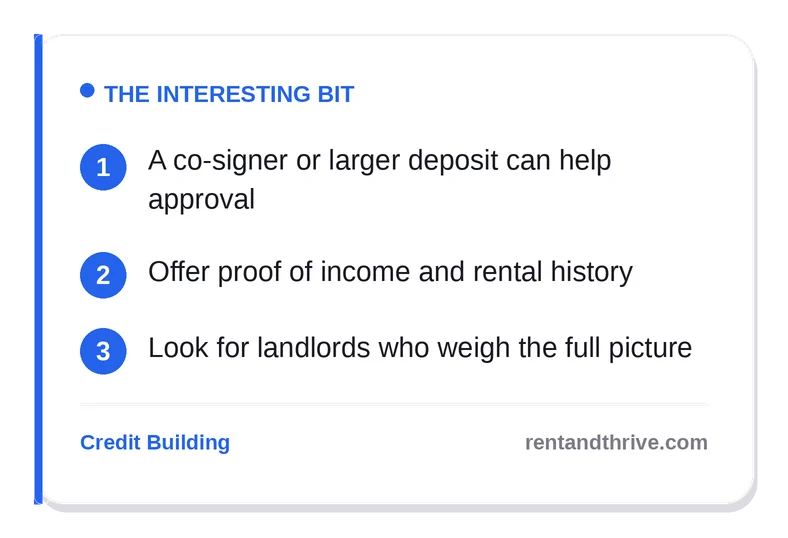
Several levers can tip a borderline application. Offer a larger deposit or a few months of rent up front if you can, which directly offsets the perceived risk. Bring references from past landlords vouching for on-time payments, and a short written explanation of any past credit trouble along with what’s changed. A creditworthy co-signer can seal an approval when your file alone won’t. Target smaller independent landlords, who often weigh the whole picture rather than running a rigid automated cutoff. Honesty and preparation beat hoping the screening is lenient, and meanwhile keep building your score so the next lease is easier.
Strengthening a Bad-Credit Application
Several moves can improve your odds. Being upfront about your credit and explaining the context, offering a larger deposit or a few months’ rent in advance where permitted, providing references from past landlords, or bringing on a qualified co-signer can each ease a landlord’s concern. Documentation of stable income is especially persuasive.
It also helps to target the right rentals, since individual owners and smaller buildings often screen more flexibly than properties with rigid score cutoffs. Combining a well-prepared application with realistic targeting, while continuing to improve your credit in the background, is the most dependable path to approval.
Improving Your Odds for the Next Application
Even if a bad-credit application succeeds with extra steps, it is worth using the tenancy to strengthen your profile for next time. Paying rent on time, and reporting it where possible, building a small emergency fund, and steadily improving your credit all make future applications easier and may reduce the need for deposits or co-signers down the road.
Keeping records of your reliable payment history gives you evidence to present to the next landlord. Each successful, well-documented tenancy makes the following one less dependent on workarounds, so today’s effort pays off in smoother approvals later.
Documenting Income and References
When credit is a concern, demonstrating that you can reliably pay rent often matters more to a landlord than the score itself. Gathering proof of steady income, recent pay stubs, an offer letter, or bank statements, and lining up references from past landlords builds a reassuring case. A strong, well-documented application can offset a weak score, especially with landlords who have flexibility.
Being upfront about your credit and briefly explaining the context, rather than hoping it goes unnoticed, tends to build trust. A low score paired with stable income and good references tells a more complete and convincing story.
Presenting this fuller picture proactively puts you in a stronger position than letting the credit check speak alone. Preparation is much of the battle.
Offering Reassurance and Targeting the Right Rentals
Several concrete steps can tip a borderline application in your favor. Where permitted, offering a larger security deposit or a few months’ rent in advance reduces a landlord’s risk, and bringing on a qualified co-signer can provide the financial backing that makes approval possible. Each of these gives a hesitant landlord a reason to say yes.
Targeting the right rentals matters too, since individual owners and smaller buildings often screen more flexibly than large properties with rigid score cutoffs. Focusing your search where flexibility is more likely saves effort and improves your odds.
Meanwhile, continuing to improve your credit in the background makes each future application easier and may reduce the need for these workarounds over time. Today’s preparation pays off in smoother approvals later.
Improving Your Profile for Next Time
Even when a bad-credit application succeeds with extra steps, the tenancy itself is a chance to strengthen your position for the future. Paying rent on time, reporting it where possible, building a small emergency fund, and steadily improving your credit all make the next application easier and may reduce the need for large deposits or co-signers down the road.
Keeping records of your reliable payment history gives you concrete evidence to present to the next landlord. Each successful, well-documented tenancy makes the following one less dependent on workarounds, so the effort you put in now pays off in smoother, less stressful approvals later.
Continuing to Build Credit in the Background
Even after securing an apartment despite weak credit, continuing to improve your credit makes future housing easier to obtain. Paying rent on time, reporting it where possible, keeping balances low, and correcting any report errors gradually strengthen your profile, which may reduce the need for large deposits or co-signers next time. Progress in the background pays off at the next application.
Keeping records of your reliable payment history also gives you evidence to present to future landlords. Each successful, well-documented tenancy makes the following one less dependent on workarounds, turning today’s effort into smoother approvals down the road.
Frequently Asked Questions
Can I rent with bad credit?
Often yes, with a co-signer, a larger deposit, or proof of steady income.
What helps approval?
Rental history, income proof, and landlords who weigh the full picture.
Should I be upfront?
Being prepared with documentation tends to help your case.
Related reading
- How to Negotiate Rent on a New Apartment (Before You Move In)
- Apartment Red Flags to Watch For Before You Sign
- First Apartment Checklist: What You Actually Need to Buy
- How to Pack an Entire Apartment in One Weekend