How to Check Your Credit Score for Free (And What to Do Next)
Checking your credit score is free and harmless, and it is the natural first step toward improving it. What you do in the days after you see the number matters more than the number itself.
Where to Check Your Score and Report for Free
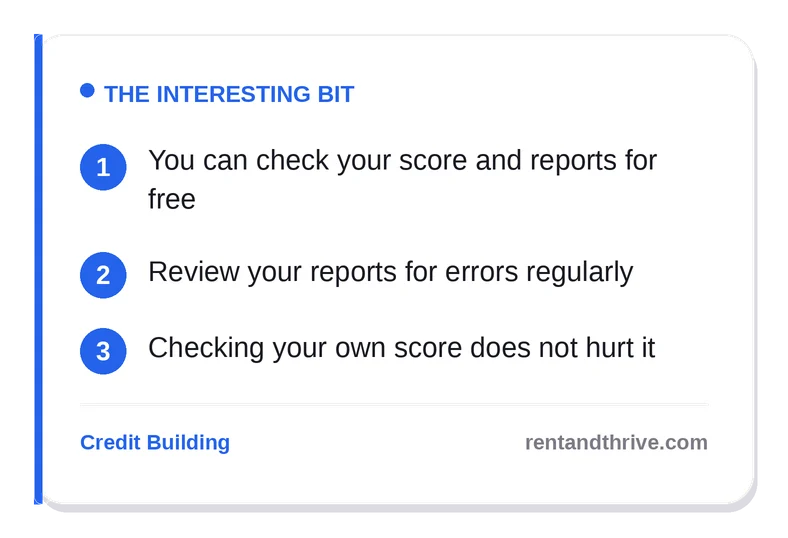
Your credit score and your full credit report are two different things, and both are available at no cost. Many banks and card issuers now show a score for free, and federal rules entitle you to your reports from the major bureaus through the official annual source. Checking your own credit is a soft inquiry, so it never lowers your score, no matter how often you look.
Because lenders may pull from different bureaus, it is worth reviewing all three reports rather than assuming they match. Differences between them are common and occasionally signal an error worth chasing down.
What to Do the Week After You Check Your Score
Pulling your score for free is the easy part; the value comes from what you do next. When the number lands, don’t just note it, read the factors listed beside it. Most free tools tell you exactly what’s holding the score down: high utilization, a short history, a recent late payment, or too few account types. Those notes are your to-do list, ranked by impact.
Within the same week, take one concrete action. If utilization is the flag, make an extra payment before your statement closes so a lower balance gets reported. If a late payment is dragging you down, set up autopay so it never repeats. If your file is thin, that’s the moment to consider a secured card or rent reporting. Also scan the report itself for errors, accounts you don’t recognize or balances that look wrong, because disputing a mistake is one of the fastest legitimate ways to lift a score. Checking your own score is a soft inquiry and never hurts it.
What to Do in the Week After You Check
Once you have the number, read the report behind it. Confirm that the accounts, balances, and payment history are accurate, and flag anything you do not recognize, since errors and signs of fraud are easier to fix when caught early. Disputing a genuine mistake with the bureau is free and can sometimes move a score on its own.
Next, look at the factors driving the score: payment history and the share of your credit limits you are using tend to carry the most weight. Setting up automatic minimum payments and bringing down high balances are usually the highest-impact moves, and they are within your control regardless of where your starting score sits.
Building Habits That Keep the Score Climbing
A single check of your score is only useful if it leads to ongoing habits. Setting calendar reminders to review your credit periodically, keeping balances low, and never missing a due date are what move a score steadily over time. Monitoring is the start; consistent behavior is what actually raises the number.
Many banks and free services let you watch your score regularly without any cost or harm, which makes it easy to notice both progress and problems early. Treating the check as a recurring tune-up, rather than a one-time event, is how the score keeps trending up.
Reading What’s Actually in Your Credit Report
The score is a summary, but the report behind it is where the real information lives, so learning to read it is worth the time. A credit report typically lists your accounts and their balances, your payment history, the dates accounts were opened, recent inquiries, and any items in collections or public records. Each of these feeds the score in some way, which is why scanning the whole report tells you far more than the number alone.
Pay particular attention to anything you do not recognize, since an unfamiliar account or a wrong balance can signal an error or fraud. Confirming that your on-time payments are recorded correctly, and that closed accounts show as closed, ensures the report reflects reality.
Because the three major bureaus may hold slightly different information, reviewing all three rather than assuming they match is a good habit. Differences are common and occasionally reveal a mistake worth disputing on just one report.
How Often to Check and What the Ranges Mean
Checking your own credit is a soft inquiry, so it never harms your score no matter how frequently you look. Many people review their score monthly through a free bank or card feature and pull their full reports a few times a year, which is usually enough to track progress and catch problems early. Regular checking also lets you spot signs of fraud while they are still easy to address.
Scores generally fall along a range from poor to excellent, and while the exact bands vary by model, higher scores tend to unlock easier approvals and better terms. Rather than fixating on a single number, it helps to watch the trend, since steady improvement reflects the habits that matter.
If your score is lower than you would like, the report shows you why, which factors are dragging it down, so you can focus your effort. Treating the check as a diagnostic rather than a verdict keeps it constructive.
Acting on What the Score Tells You
A score is most useful when it prompts action rather than worry. Once you know the number and the factors behind it, the highest-impact moves are usually within reach: bringing down high card balances, setting up automatic payments so nothing is ever late, and correcting any errors you find. Each of these targets a factor you control, regardless of where your starting score sits.
Tracking the score over the following months then shows whether those habits are working, which is far more motivating than a single snapshot. Treating the check as the start of an ongoing routine, rather than a one-time event, is how the number steadily climbs.
Frequently Asked Questions
How can I check my credit for free?
Free tools and the official annual report service let you see your score and reports at no cost.
Does checking my own credit hurt it?
No, checking your own score is a soft inquiry and does not affect it.
Why review my reports?
To catch errors that could be dragging your score down.
Related reading
- How Rent Reporting Services Can Boost Your Credit Score
- Credit Utilization: The Number That Secretly Tanks Your Score
- How to Get Approved for an Apartment With Bad Credit
- Credit Builder Loans: Are They Worth It?