
Sinking Funds Explained: How Renters Can Prepare for Big Expenses
A sinking fund is money you set aside gradually for a known future expense, so the cost arrives already paid for. For renters, the lease itself maps out many of these expenses in advance.
Which Renter Expenses Deserve a Sinking Fund
Sinking funds work best for costs that are predictable in timing or amount even if they are not monthly: an annual renter’s insurance premium, a registration or move-related fee, holiday spending, or the deposit on a future apartment. Naming each goal separately keeps the money from blurring into general savings and getting spent.
Renters often overlook lease-driven costs in particular, the next security deposit, potential move-out cleaning, or a pet fee at renewal. Planning for these ahead of time turns a stressful lump sum into a series of small, manageable contributions.
Building a Sinking-Fund Calendar Around Your Lease
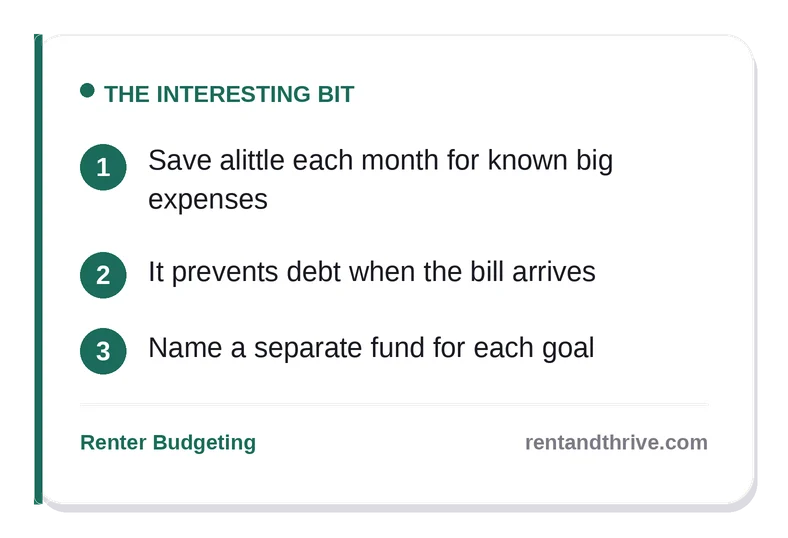
A sinking fund is just saving a little each month for a known future expense, so the bill never feels like an emergency. Renters have a surprisingly predictable set of these: annual renter’s insurance, lease-renewal or administrative fees, the holidays, a yearly car registration, and the big one, the deposit and moving costs for an eventual move. List each, note its due date and total, and divide by the months until then.
Mapping these against your lease calendar is what makes the system click. If your lease renews in October with a fee, and insurance renews in March, you’ll see exactly which months carry extra load and can smooth your saving accordingly. Park the money in one savings account and track the categories on a simple spreadsheet rather than opening a dozen accounts. When the bill arrives the cash is already waiting, and you avoid the classic renter trap of reaching for a credit card every time a foreseeable expense lands.
Setting Up a Simple Sinking-Fund System
The math is straightforward: divide the expected cost by the number of months until you need it, and save that amount each month. Many banks let you create multiple named savings buckets at no cost, which makes it easy to see each fund’s progress without opening separate accounts.
Tying contributions to payday and reviewing the list every few months keeps it accurate, since goals and timelines shift. The payoff is psychological as much as financial, because a known expense that is already funded simply stops being an emergency.
Keeping Sinking Funds Separate From Spending
The biggest threat to a sinking fund is accidentally spending it, which is why keeping the money distinct from your everyday checking matters. Named savings buckets or a separate account make each goal visible and create just enough friction that you think twice before raiding it for something unrelated. Out of sight from daily spending, the funds are far more likely to be there when the expense arrives.
Reviewing the list of funds every few months keeps it honest, letting you retire goals you have met, adjust amounts, and add new ones as your plans evolve. A tidy set of clearly labeled funds is easier to trust and maintain than a single vague savings pile.
How Sinking Funds Differ From an Emergency Fund
Sinking funds and emergency funds are both savings, but they serve different jobs, and confusing them can leave you underprepared. A sinking fund is for a known, expected expense you are deliberately saving toward, like an annual premium or a future move, while an emergency fund is for the genuinely unexpected. Keeping them separate means a planned expense never has to raid the safety net meant for true surprises.
Used together, they cover both sides of irregular spending: the costs you can see coming and the ones you cannot. Funding sinking funds for the predictable items actually protects your emergency fund, because fewer expenses end up qualifying as emergencies when you have planned for the foreseeable ones.
Prioritizing When You Have Several Sinking Funds
Most renters end up with more potential sinking funds than they can fund at once, so prioritization matters. Ranking them by urgency and certainty, the expenses that are soonest and most unavoidable first, ensures the money goes where it is most needed. A fund for a deposit due in a few months generally takes precedence over one for a distant, optional goal.
It also helps to fund the time-sensitive goals fully before spreading money thinly across many, since a half-funded urgent expense still leaves you short when it arrives. Reviewing the list periodically lets you retire completed funds and redirect that money toward the next priority, keeping the whole system aligned with your real timeline.
Automating Contributions So Funds Grow on Their Own
The most reliable sinking funds are the ones you do not have to think about, which is why automation helps so much. Setting up a recurring transfer on payday into each fund means the money accumulates steadily before you can spend it, turning a series of small, painless contributions into a fully funded expense by the time it arrives. Automation removes the willpower from the equation.
Many banks let you create and name multiple savings buckets at no cost, making it easy to direct automatic transfers to each goal and watch its progress. Reviewing the amounts every few months keeps them accurate as costs and timelines change, but day to day, automation lets the funds quietly do their job.
Frequently Asked Questions
What is a sinking fund?
Money set aside a little at a time for a known future expense.
How is it different from an emergency fund?
A sinking fund is for planned costs; an emergency fund is for surprises.
What should I use one for?
Things like insurance premiums, car repairs, or holiday spending.
Related reading
- Index Funds for Beginners: The Easiest Way Renters Can Build Wealth
- Renters Insurance Explained: What It Covers and How Much You Actually Need
- Emergency Fund vs. Investing: Which Should Renters Prioritize?
- REITs: How Renters Can Invest in Real Estate Without Buying Property