
How to Build a Zero-Based Budget on a Renter’s Income
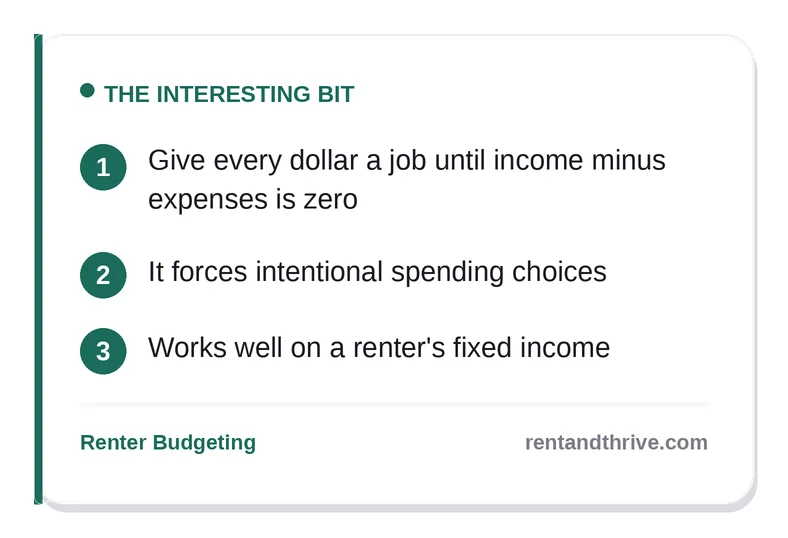
Zero-based budgeting means giving every dollar of your take-home pay a job before the month begins, so your income minus your assignments always equals zero. For renters with a fixed rent payment and flexible everything-else, it is one of the clearest ways to see where your money actually goes.
Why Zero-Based Budgeting Fits a Renter’s Cash Flow
Renters usually have one large, predictable expense (rent) and a long tail of smaller, controllable ones. Zero-based budgeting leans into that reality by forcing you to name a destination for every dollar, whether it is rent, groceries, a sinking fund, or savings. Because nothing is left unassigned, the money that normally disappears into vague “miscellaneous” spending gets pulled into the light.
The method also adapts well to a renewal or a rent increase. When your housing cost changes, you simply rebuild the plan from zero rather than patching an old one, which keeps the budget honest instead of slowly drifting out of date.
A Sample Zero-Based Month for a Renter
Say you bring home $3,000 a month. A zero-based plan assigns every dollar before the month starts: rent, groceries, utilities, phone, transportation, an emergency-fund transfer, a sinking fund for insurance and annual fees, debt payoff, and the rest to flexible spending until you hit zero. The point isn’t restriction; it’s intention. Every dollar has a job, so nothing leaks away unnoticed.
Renters benefit from this method more than homeowners because so many rental costs are lumpy: a deposit here, a lease-renewal fee there, a surprise utility transfer. Building those into named categories each month means they never blindside you. Revisit the plan on the first of every month, because your real spending will drift, and a budget you don’t update is just a wish. After two or three cycles the numbers get realistic and the whole system runs on autopilot.
Common Pitfalls and How to Stay Consistent
The most common stumble is building a budget so strict it collapses by the second week. Leaving a realistic amount for everyday spending and a small guilt-free category makes the plan something you can actually live with. It also helps to budget the income you already have rather than money you expect later, which keeps the numbers grounded.
Consistency comes from a short monthly reset and a quick mid-month check-in, not from perfection. If a category runs over, move money from another line instead of abandoning the whole system. After a few cycles the process becomes routine, and the budget starts to feel like a tool rather than a chore.
Adapting the System as Your Income Grows
A zero-based budget is not a one-time setup but a living plan that should change as your circumstances do. When you get a raise, a roommate, or a cheaper renewal, the extra room is a chance to assign more dollars to savings and goals rather than letting spending quietly expand to fill the gap. Deciding in advance where new income goes keeps lifestyle creep in check.
The same flexibility helps in leaner months. Because every dollar is already assigned, trimming the plan is a matter of reprioritizing categories rather than starting over, which keeps the budget useful through both good stretches and tight ones.
Handling Irregular Expenses in a Zero-Based Plan
The trickiest part of a zero-based budget is the expenses that are real but not monthly, an annual renewal fee, a quarterly insurance premium, a holiday, or a car repair that you know is coming eventually even if not this month. If you ignore them, they blow up the plan when they land, and you end up borrowing from rent or reaching for a credit card. The cleaner approach is to give each of these a monthly line even in months you do not pay them.
Practically, that means estimating the yearly cost, dividing it across twelve months, and assigning that slice every month into a dedicated savings bucket. By the time the bill arrives, the money is already there, and your zero-based month stays balanced instead of being thrown off by a predictable-but-irregular cost. Treating these as ordinary monthly assignments, rather than surprises, is what keeps a tight budget from constantly breaking.
Tools That Make Zero-Based Budgeting Easier
Zero-based budgeting is just a method, so it works with whatever tool you will actually maintain, a spreadsheet, a notebook, or a dedicated app. Spreadsheets give you full control and cost nothing, which suits people who like to see every formula, while apps that automatically import transactions reduce the manual entry that causes many people to quit. The right choice is the one whose upkeep you do not dread.
Whatever you use, a few features make the method smoother: the ability to assign every dollar to a category, to carry leftover money forward, and to see at a glance whether your assignments still sum to your income. Reviewing the plan briefly each week and resetting it each month keeps it accurate as your spending and income shift over time.
Staying Flexible When the Month Goes Sideways
No zero-based plan survives a month perfectly, and the measure of a good budgeter is not avoiding overspending in one category but adjusting when it happens. When a line runs over, the move is to cover it by pulling from another category rather than abandoning the plan, which keeps every dollar accounted for even as the details shift. This flexibility is what separates a budget you stick with from one you quit after the first bad week.
Building in a modest buffer category for the genuinely unexpected gives you a release valve so a single surprise does not force a scramble. Over a few cycles, you learn where your estimates tend to fall short and can assign more realistically, which makes each month’s plan smoother than the last.
Frequently Asked Questions
What is a zero-based budget?
A budget where you assign every dollar of income to a category until nothing is left unassigned.
Does zero-based mean spending everything?
No, savings and debt payments are categories, so dollars are assigned to goals, not spent.
Is it good for renters?
Yes, it suits a fixed renter income by making every dollar intentional.
Related reading
- How to Invest $100 a Month as a Renter and Actually Build Wealth
- Dollar-Cost Averaging: How to Invest Consistently on a Renter’s Budget
- How to Budget When Your Income Is Irregular
- Renter Budget Templates: The 5 Best Free Options