
How to Budget When Your Income Is Irregular
Irregular income, from freelancing, tips, commissions, or seasonal work, makes a standard monthly budget feel impossible. The fix is to budget around your reliable floor rather than your hopeful average.
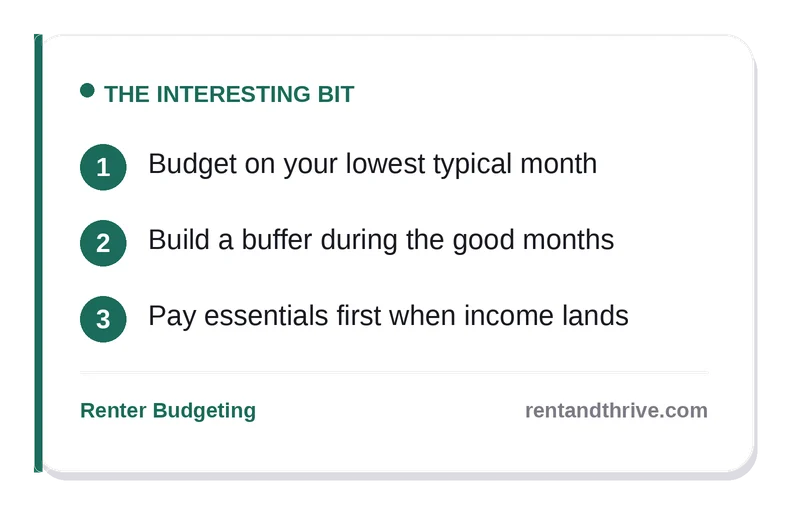
Budgeting From Your Lowest Likely Month
When income swings, averaging good and bad months hides the risk of the lean ones. A steadier approach is to identify a conservative baseline, roughly what you can count on even in a slow stretch, and build your essential budget around that figure. Rent, utilities, food, and minimum obligations should fit inside the floor, not the peak.
This means that during strong months you are deliberately living below your income. That gap is not lost money; it is the raw material for the buffer that smooths out the slow months to come.
Budgeting Around the Lowest Month, Not the Average
Irregular income breaks ordinary budgets because they assume a steady paycheck. The fix is to stop budgeting from what you hope to earn and start from what you reliably earn. Look back over the last twelve months, find your lowest-earning month, and build your baseline budget, rent, utilities, groceries, minimums, around that floor. Anything above the floor in a good month becomes fuel for goals, not lifestyle creep.
Set up a buffer account that smooths the peaks and valleys: in strong months route the surplus there; in lean months top up your checking from it to cover the gap. Aim to eventually hold one full month of expenses in that buffer so you’re always spending last month’s income, not this month’s uncertainty. Renters with variable pay should also keep deposit-and-moving cash separate, since a lease change can collide with a slow earning stretch. Predictability is something you engineer, not something irregular work hands you.
Using a Buffer Account to Smooth the Swings
A practical system is to route variable income into a holding account and pay yourself a consistent monthly “salary” from it. In high-earning months the account fills; in lean months it covers the shortfall, so your day-to-day budget stays stable even though your income does not. Building that buffer up first is the hardest but most valuable step.
Because taxes are often not withheld on this kind of income, setting aside a portion for them as money arrives prevents an unwelcome surprise later. A tax professional can help you estimate the right percentage for your situation, which keeps the buffer doing its real job instead of being drained at filing time.
Prioritizing Bills When Income Arrives Unevenly
With irregular income, the order in which you cover obligations matters as much as the budget itself. Funding the non-negotiables first, rent, utilities, food, minimum debt payments, the moment money comes in protects you from a slow month leaving essentials unpaid. Lower-priority spending waits until the must-pays are secured.
Keeping a list of bills ranked by importance, and topping up the buffer account whenever there is surplus, turns unpredictable earnings into predictable coverage. The buffer absorbs the timing mismatches, so even when income is lumpy, your essential bills stay on schedule.
Separating Business and Personal Money
For renters earning irregular income through freelancing or a small business, keeping that money separate from personal finances prevents a great deal of confusion. A dedicated account for business income and expenses makes it far easier to see your true earnings, track deductible costs, and set aside what you owe, rather than having everything blur together in one checking account. The separation also makes budgeting your personal life from a steady draw much cleaner.
This division becomes especially valuable at tax time, when untangling mixed transactions is tedious and error-prone. Even a simple separation, one account for the work, one for personal spending, brings order to income that arrives unpredictably, and a tax professional can advise on the right structure for your situation.
Planning for Taxes and Retirement on Variable Income
Irregular income often arrives without taxes withheld, which means the responsibility to set money aside falls on you. Reserving a portion of each payment for taxes as it comes in, rather than scrambling at filing time, prevents an unwelcome bill, and a tax professional can help estimate the right percentage for your circumstances. Treating that set-aside as untouchable keeps it from being spent during a good month.
Retirement saving also requires more intention without an employer plan, but options exist for self-employed and gig workers to save in tax-advantaged ways. Contributing in stronger months, even irregularly, lets you build long-term savings around a variable income, and professional guidance can clarify which accounts fit your earnings and goals.
Building a Bigger Buffer for Long Slow Stretches
Renters with irregular income benefit from a larger cash cushion than those with steady paychecks, because a slow stretch can last longer than a single month. Building the buffer account up beyond just one month’s expenses provides protection when several lean months stack together, which is a real risk in seasonal or commission-based work. The extra cushion turns an unpredictable income into a predictable monthly draw.
Funding that buffer during strong months, rather than letting good income inflate spending, is the discipline that makes the whole system work. Once the cushion is robust, the day-to-day budget can stay stable regardless of how lumpy the underlying income is, which is the entire point of budgeting around the lowest month.
Frequently Asked Questions
How do I budget with irregular income?
Budget on your lowest typical month and build a buffer in better months.
What do I pay first?
Cover essentials first when income arrives, then fund your goals.
How big should my buffer be?
Enough to smooth out your slow months; a larger cushion helps more.
Related reading
- How to Build a Zero-Based Budget on a Renter’s Income
- Side Hustle to Investment: How to Turn Extra Income Into Long-Term Wealth
- Dollar-Cost Averaging: How to Invest Consistently on a Renter’s Budget
- How to Find the Best Neighborhood for Your Budget