
Tax-Advantaged Accounts Every Renter Should Know About
Tax-advantaged accounts let your money grow with a tax break attached, which can make a real difference over time. Knowing the main types helps renters put their savings in the right places.
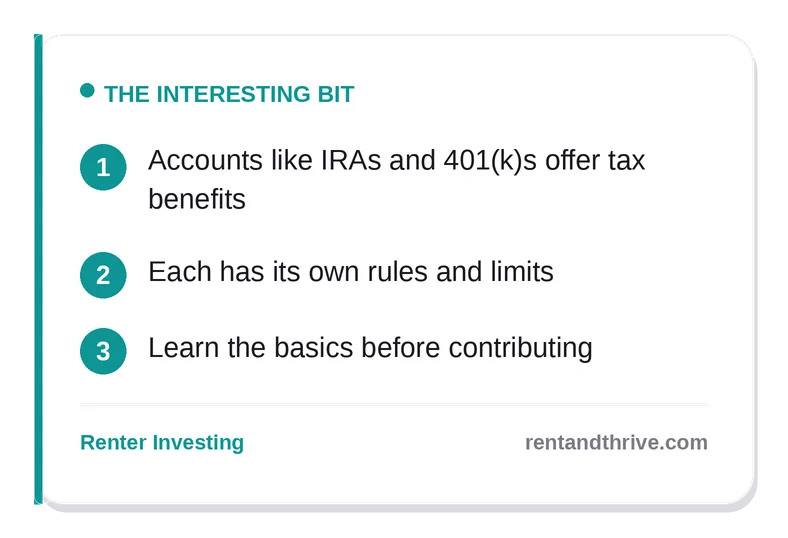
The Main Tax-Advantaged Accounts to Know
Several account types offer tax benefits for specific goals. Workplace retirement plans like a 401(k), individual retirement accounts in Roth and traditional forms, and health savings accounts for those with qualifying coverage each provide a way to reduce taxes either now or in the future. Some renters also encounter other specialized accounts depending on their goals, but these are the most broadly relevant.
Each comes with its own rules, contribution limits, and intended purpose, so the value lies in matching the account to the goal, retirement, healthcare, and so on, rather than treating them interchangeably.
Mapping the Tax-Advantaged Accounts Worth Knowing
Tax-advantaged accounts are among the most valuable tools for building wealth, yet renters often leave them unused simply because the alphabet soup is confusing. The major ones, IRAs, 401(k)s, and HSAs, share a common theme: they offer tax benefits in exchange for using them as intended, and each has its own rules, contribution limits, and ideal use case. Learning the basics before contributing lets you put each dollar where it works hardest.
A rough map helps. A workplace 401(k) is usually the first stop if there’s an employer match, since that match is free money. An IRA, Roth or Traditional, gives you flexible retirement saving on your own terms, with the Roth’s tax-free growth often favoring younger renters. An HSA, available with a qualifying health plan, carries an unmatched triple tax advantage. Each has annual limits and early-withdrawal rules worth understanding so you don’t trip a penalty. You don’t need to use all of them at once; start with the one that fits your situation, typically the matched 401(k) or a Roth IRA, and add others as your income and knowledge grow.
Mapping the Accounts to Your Goals
A practical way to think about it is by priority: capturing any employer retirement match first, since it is essentially free money, then using IRAs or an HSA where eligible to add tax-advantaged growth. The right mix depends on whether you value a tax break now or later and on which goals you are funding, so the choice is personal.
Because contribution limits, eligibility, and tax rules can be detailed and change over time, it is worth confirming the current specifics and, for bigger decisions, consulting a tax or financial professional. Used well, these accounts let renters keep more of what they earn working for them over the long run.
Setting Priorities Among the Accounts
With several tax-advantaged options available, a sensible order helps. Capturing any employer retirement match first is common guidance, since it is essentially free money, followed by funding an IRA or an HSA where eligible to add more tax-advantaged growth. The best sequence depends on your goals and whether you prefer a tax break now or later.
Because contribution limits, eligibility, and rules change over time, confirming the current specifics matters, and a tax or financial professional can help with bigger decisions. Used in a thoughtful order, these accounts let renters keep more of their money working toward the future.
Knowing the Main Account Types
Several tax-advantaged account types serve different goals: workplace retirement plans like a 401(k), individual retirement accounts in Roth and traditional forms, and health savings accounts for those with qualifying coverage. Each provides a way to reduce taxes either now or in the future, and each comes with its own rules, limits, and intended purpose. Matching the account to the goal is where the value lies.
Some renters encounter other specialized accounts depending on their goals, but these are the most broadly relevant. Understanding what each is for, rather than treating them interchangeably, is the first step to using them well.
Prioritizing Among the Accounts
A practical way to think about it is by priority: capturing any employer retirement match first, since it is essentially free money, then using IRAs or an HSA where eligible to add tax-advantaged growth. The right mix depends on whether you value a tax break now or later and on which goals you are funding, so the order is somewhat personal.
Funding the highest-value opportunities first ensures you are not leaving easy benefits on the table. Beyond the match, choosing between account types comes down to your tax outlook and circumstances, which is worth thinking through deliberately.
Keeping Up With Changing Rules
Contribution limits, eligibility, and tax rules for these accounts can be detailed and change over time, so confirming the current specifics matters before relying on them. What was true a few years ago may have shifted, and details like income limits can affect which accounts you can use. A quick check keeps your plan accurate.
For bigger decisions, consulting a tax or financial professional helps you apply the rules to your own situation. Used well and kept current, these accounts let renters keep more of what they earn working toward the future over the long run.
Letting Your Account Mix Evolve With Your Life
Which tax-advantaged accounts make sense for you will change as your career and income evolve, so the mix is worth revisiting periodically rather than setting once. A new job with a retirement plan, a change in health coverage, or a shift in income can each open or close certain options, and adjusting accordingly keeps your strategy current.
Because eligibility and limits can change with the rules as well as with your circumstances, a quick check now and then keeps your plan accurate. For bigger decisions, a tax or financial professional can help you adapt the mix to where you are, ensuring these accounts keep working in your favor.
Frequently Asked Questions
What are tax-advantaged accounts?
Accounts like IRAs, 401(k)s, and HSAs that offer tax benefits.
Why use them?
The tax benefits can help your money grow more efficiently.
Are there limits?
Yes, each has its own rules and contribution limits.
Related reading
- What Every Renter Should Read Before Signing a Lease
- How to Invest $100 a Month as a Renter and Actually Build Wealth
- Emergency Fund vs. Investing: Which Should Renters Prioritize?
- Dollar-Cost Averaging: How to Invest Consistently on a Renter’s Budget