
How to Use Your Employer’s 401(k) Match to Build Wealth Faster
An employer 401(k) match is one of the few genuinely free boosts to your finances, money your employer adds when you contribute. Capturing the full match is usually the highest-priority investing move available.
Why the Match Comes First
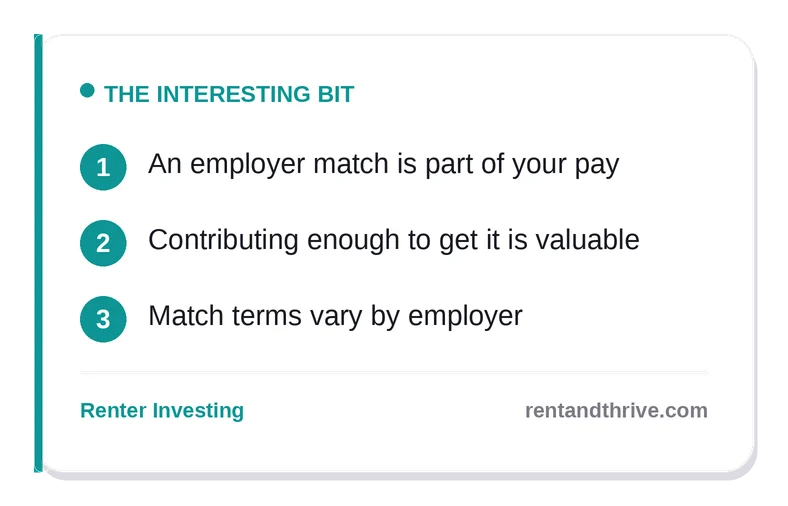
A match means your employer contributes additional money to your retirement account based on what you put in, up to a limit. Failing to contribute enough to earn the full match effectively leaves part of your compensation unclaimed, which is why financial guidance so often treats capturing it as a top priority, ahead of many other goals. The return on that matched portion is immediate.
Even for renters juggling other priorities, the match is hard to beat because nothing else reliably adds money to your contribution the moment you make it. Understanding your plan’s match formula is the first step to making sure you are not leaving any of it behind.
Capturing Your Full 401(k) Match
If your employer offers a 401(k) match, it is the closest thing to free money in personal finance, and skipping it leaves part of your compensation on the table. A typical arrangement might match your contributions up to a few percent of your salary, meaning every dollar you put in, up to that cap, is immediately doubled before any market growth. No investment reliably returns 100 percent instantly the way a full match does.
The priority is clear: contribute at least enough to capture the entire match before funneling extra money elsewhere. Match terms vary by employer, so read your plan’s details, the percentage matched, the cap, and any vesting schedule that determines how long you must stay to keep the matched funds. Renters sometimes assume retirement saving can wait until they own a home, but the match makes the cost of waiting enormous, since each year missed is compensation gone for good. Even on a tight budget, set your contribution to hit the full match and treat it as a non-negotiable bill. It’s a raise you simply have to opt into.
Capturing Your Full Match
The practical step is to learn exactly how your plan matches, the percentage and the cap, and to contribute at least enough to earn all of it. Setting your contribution to meet the full match, then automating it from each paycheck, ensures you capture the benefit without having to think about it monthly. Many people start there and increase contributions gradually as their budget allows.
It also helps to understand your plan’s vesting schedule, which determines when the matched money is fully yours, since leaving early can forfeit unvested amounts. Beyond the match, contributions still grow tax-advantaged, but the matched portion is the part you most want to be sure you are not missing.
Increasing Contributions Over Time
Capturing the full employer match is the first priority, but it does not have to be the last. Once the match is secured, gradually raising your contribution, especially when you get a raise, lets more of your income grow tax-advantaged without a painful adjustment to your budget. Small, regular increases compound meaningfully over a career.
Some plans offer automatic annual increases, which make this effortless. Understanding your plan’s vesting schedule also ensures you know when matched funds are fully yours, so you can factor that into any decision about changing jobs.
Learning Your Plan’s Match Formula
Capturing an employer 401(k) match starts with understanding exactly how your plan matches, since formulas vary, a common structure matches a percentage of your contributions up to a limit. Contributing at least enough to earn the full match ensures you are not leaving part of your compensation unclaimed, which is why guidance so often treats it as a top priority. The return on the matched portion is immediate.
Reading your plan documents or asking HR clarifies the percentage and cap. Once you know the formula, setting your contribution to meet the full match, and automating it, ensures you capture the benefit without having to think about it each month.
Understanding Vesting Schedules
Matched contributions are not always immediately yours, because many plans use a vesting schedule that determines when the employer’s money fully belongs to you. Leaving a job before you are fully vested can forfeit some of the unvested match, so understanding your plan’s schedule helps you factor it into decisions about changing jobs. Your own contributions, by contrast, are always yours.
Knowing where you stand on vesting lets you plan around it, for instance, if you are close to a milestone that would secure more of the match. It is a detail worth checking rather than assuming the matched money is instantly yours.
Increasing Contributions Beyond the Match
Capturing the full match is the first priority, but it does not have to be the last. Once the match is secured, gradually raising your contribution, especially when you get a raise, lets more of your income grow tax-advantaged without a painful budget adjustment. Small, regular increases compound meaningfully over a career.
Some plans offer automatic annual increases, which make this effortless. Beyond the match, contributions still grow tax-advantaged, so continuing to build the habit, after securing the free matched money first, is a sound way to accelerate long-term saving.
Treating the Match as a Top Financial Priority
Because an employer match is essentially free money added to your contributions, capturing it in full is one of the highest-return moves available, which is why it so often comes ahead of other goals. Contributing at least enough to earn the entire match ensures you are not leaving part of your compensation unclaimed. Few other financial steps offer such an immediate benefit.
Even for renters juggling competing priorities, the match is hard to beat, since nothing else reliably adds money the moment you contribute. Setting your contribution to capture it fully, and automating it, locks in that benefit without ongoing effort.
Frequently Asked Questions
What is a 401(k) match?
Money your employer adds when you contribute, up to a limit.
Why contribute enough to get it?
The match is essentially part of your pay you would otherwise leave behind.
Do all employers match?
No, match terms vary, so check your plan.
Related reading
- How to Invest $100 a Month as a Renter and Actually Build Wealth
- Index Funds for Beginners: The Easiest Way Renters Can Build Wealth
- Side Hustle to Investment: How to Turn Extra Income Into Long-Term Wealth
- How Long Does It Take to Build Good Credit From Scratch?