Credit Utilization: The Number That Secretly Tanks Your Score
Credit utilization, the share of your available credit you are using, is one of the most influential and fastest-moving parts of a credit score. A few timing tweaks can lower the number lenders see without changing how you actually spend.
Why Utilization Carries So Much Weight
Utilization compares your reported balances to your credit limits, and a lower ratio generally signals to lenders that you are not overextended. Because it is recalculated with each new statement, it can influence your score far more quickly than slower factors like account age, which makes it a powerful lever for renters looking to improve fast.
Both your overall utilization and the figure on individual cards can matter. Keeping reported balances well below your limits, rather than maxing out even one card, is the general aim, and there is no benefit to carrying a balance to “build” credit, which is a persistent myth.
The Statement-Date Trick That Quietly Lifts Your Score
Credit utilization, the share of your available credit you’re using, is one of the most powerful and most misunderstood score factors. Here’s the part that trips renters up: the balance that matters is usually the one reported on your statement closing date, not the balance after you pay. So you can pay in full every month, never owe a cent of interest, and still show high utilization if you charge a lot before the statement closes.
The fix costs nothing. Make a payment a few days before your statement date to knock the reported balance down, then pay any remainder as usual. Keeping the reported figure under 30 percent of your limit helps, and under 10 percent is better still. Spreading charges across cards, or asking for a credit-limit increase you don’t actually use, also lowers the ratio. Because utilization has no memory, it resets each month, this is one of the few score levers that can move your number in a single billing cycle rather than over years.
The Statement-Date Trick That Lowers the Number
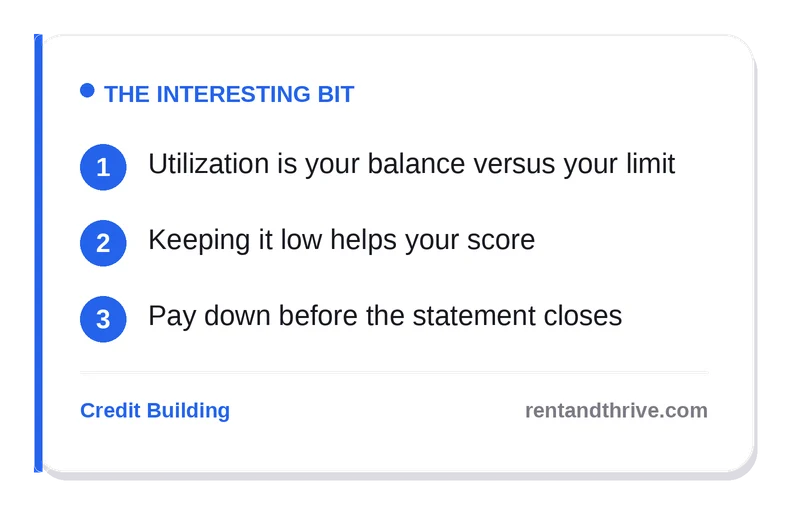
Card issuers usually report your balance to the bureaus on or around your statement closing date, not your payment due date. That means a card can show a high balance even if you always pay in full, simply because the snapshot was taken before your payment posted. Knowing your closing date lets you act on this.
Paying down the balance before the statement closes, rather than waiting for the due date, causes a lower figure to be reported, which can quietly lift your score. Some people make an extra mid-cycle payment for the same effect. It is a timing adjustment, not new spending discipline, but it changes the number lenders actually see.
Keeping Utilization Low Month After Month
Because utilization resets with each statement, the benefit of a low ratio is not permanent, it has to be maintained. Building the habit of paying down balances before the statement closes, or making mid-cycle payments, keeps the reported figure consistently low rather than only good in the month you happened to focus on it.
Requesting a credit limit increase, used responsibly, can also lower your ratio by raising the denominator, as long as your spending does not rise to match. The aim is a steady, low utilization that supports your score over time, not a one-month fix.
Overall Versus Per-Card Utilization
Credit utilization is measured both overall, across all your revolving accounts, and on each individual card, and both can influence your score. A low total utilization is generally favorable, but a single card carried near its limit can still be a drag even if your overall ratio looks fine. Spreading balances or paying down the most-used card helps on both measures.
Because utilization is recalculated with each statement, it is one of the faster-moving factors in a score, which makes it a useful lever for quick improvement. Keeping reported balances well below your limits, rather than maxing out any one card, is the general aim.
There is no benefit to carrying a balance to “build” credit; paying in full is both cheaper and good for your score. That persistent myth costs people interest for no gain.
Raising Limits and Timing Payments
One way to lower your utilization without changing your spending is to increase your available credit, for example by requesting a limit increase on an existing card. As long as your balances stay the same, a higher limit reduces the ratio, which can help your score, though it only works if you avoid the temptation to spend more. Used responsibly, it is a quiet, effective adjustment.
Timing also matters, because issuers typically report your balance on the statement closing date, not the due date. Paying down the balance before the statement closes causes a lower figure to be reported, even if you always pay in full, which can lift the utilization component of your score.
Combining a sensible limit with well-timed payments keeps reported utilization consistently low. These are mechanical tweaks rather than spending sacrifices, which is what makes them appealing.
Keeping Utilization Low as a Lasting Habit
Because utilization resets with every statement, a low ratio has to be maintained rather than achieved once. Building the habit of paying down balances before the statement closes, or making an extra mid-cycle payment, keeps the reported figure consistently low instead of good only in the month you happened to focus on it. Consistency is what turns this into a durable score support.
It also helps to avoid letting balances drift up as limits rise, since the benefit of a higher limit disappears if spending climbs to match. A steady, low utilization, kept up month after month, quietly reinforces your score far more than any one-time effort.
Frequently Asked Questions
What is credit utilization?
The share of your available credit you are using, your balance versus your limit.
What utilization is good?
Lower is generally better for your score.
How do I lower it?
Pay down balances, ideally before the statement closes.
Related reading
- How Rent Reporting Services Can Boost Your Credit Score
- How to Check Your Credit Score for Free (And What to Do Next)
- How to Get Approved for an Apartment With Bad Credit
- Credit Builder Loans: Are They Worth It?