
Renter Budget Templates: The 5 Best Free Options
A budget template only works if it matches how you think about money. The best free option is the one whose structure feels natural enough that you keep filling it in month after month.
Matching a Template to Your Money Personality
Some people want every dollar categorized in detail, while others do better with a few broad buckets and a glance at the bottom line. Detailed spreadsheets reward those who enjoy precision and review, but they can overwhelm someone who just wants to know whether they are on track. Choosing a template that fits your tolerance for detail is the difference between a tool you use and one you ignore.
Visual learners often prefer templates with charts or color-coded categories, while list-oriented people may favor a clean table. There is no universally best layout, only the one that you find easy to open and update.
Matching a Budget Template to How Your Brain Works
Free budget templates fail for the same reason gym memberships do: they assume a level of upkeep most people won’t sustain. Before downloading another spreadsheet, be honest about your style. If you like seeing the whole picture, a category-based monthly template suits you. If detail overwhelms you, a bare-bones template with just income, fixed costs, and one flexible-spending number will get used where a fancier one gathers dust.
For renters, the template you choose should have dedicated lines for housing-adjacent costs that generic budgets bury, renter’s insurance, parking, pet rent, laundry, and a sinking-fund row for your eventual move. Start with a free option, run it for one full month, and only then customize. The first month is diagnostic: you’ll discover which categories you actually need and which ones are noise. A template earns its keep when it surfaces a decision, like noticing utilities crept up, not when it simply stores numbers you never look at again.
Free Tools and How to Customize Them
Free spreadsheet templates from established personal-finance sources, along with the basic tiers of popular budgeting apps, cover most renters’ needs without a subscription. The key is to adapt whatever you pick to your real categories, renaming lines for your actual subscriptions, commute, and lifestyle rather than living with someone else’s generic defaults.
Start simple and add complexity only if you find you need it. A template with too many categories tends to get abandoned, whereas a lean one you can complete in a few minutes each week is far more likely to stick and actually shape your spending.
Sticking With a Template Long Enough to Judge It
Any budget template feels awkward at first, so giving a chosen one a few months before deciding it does not work prevents endless tool-hopping. The early friction usually comes from learning the layout, not from a flaw in the template, and most of that fades once the routine sets in. Commitment to one method beats sampling many.
If, after a fair trial, the template genuinely fights how you think, switching is reasonable, but make the change deliberately rather than at the first sign of difficulty. The goal is a tool you will still be using a year from now, which requires patience more than the perfect spreadsheet.
Spreadsheet or App: Choosing Your Format
The first decision with any budget template is whether you want a spreadsheet or an app, because they suit different temperaments. Spreadsheets are free, endlessly customizable, and give you full visibility into the math, which appeals to people who like control and do not mind manual entry. Apps automate much of the data collection and offer reminders and charts, which helps those who would otherwise forget to update their numbers.
Neither is better in the abstract; the right one is the format you will keep using. Some people even combine them, using an app to capture transactions and a spreadsheet for the bigger-picture plan. Trying one for a month before deciding is the surest way to learn which fits how you actually manage money.
What Every Good Budget Template Includes
Regardless of format, a useful budget template shares a few essentials: a clear view of income, a place for fixed costs like rent and utilities, flexible spending categories, and a dedicated line for savings and any debt payoff. Without each of these, a template tends to hide the very trade-offs a budget is meant to reveal. A savings line in particular is easy to omit and important to keep.
The best templates also make it easy to compare planned versus actual spending, so you can see where reality diverged from the plan. Customizing the category names to match your real life, your actual subscriptions, commute, and habits, turns a generic template into one that genuinely reflects your finances.
Reviewing and Refining Your Template Over Time
A budget template is not a set-it-and-forget-it tool; the best ones get refined as you learn how you actually spend. After a few months, you may notice categories you never use, ones that need splitting, or amounts that were consistently unrealistic, and adjusting these keeps the template genuinely useful rather than slowly drifting out of date. A short periodic review is enough to keep it accurate.
Resisting the urge to add endless detail is part of this, since an overloaded template becomes a chore and gets abandoned. The goal is a living tool that reflects your current life, lean enough to maintain but specific enough to reveal where your money is really going.
Frequently Asked Questions
Do I need a budget template?
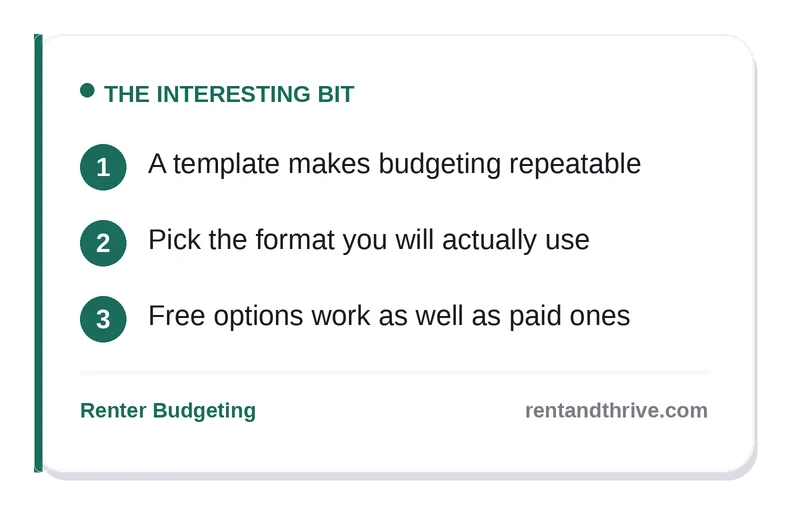
A template makes budgeting repeatable, but use whatever format you will stick with.
Are free templates good enough?
Yes, free options work as well as paid ones for most renters.
Which format is best?
The one you will actually use consistently.
Related reading
- Dollar-Cost Averaging: How to Invest Consistently on a Renter’s Budget
- How to Build a Zero-Based Budget on a Renter’s Income
- Tax-Advantaged Accounts Every Renter Should Know About
- How to Invest $100 a Month as a Renter and Actually Build Wealth